Air Fryer Troubleshooting Guide: 10 Common Problems and Safe Fixes

Your air fryer turns on, but dinner is still cold. Or maybe the display goes dark halfway through cooking. Before you order a replacement, work out what the appliance is actually doing. A cooking mistake and an electrical fault can look similar at first, but they call for very different responses.
This air fryer troubleshooting guide helps you identify the symptom, choose a safe external check and decide when to stop. Start with the appliance’s exact model instructions. Common issues can involve the settings, drawer position, food load or ventilation. Persistent faults, damage and unexplained smoke need professional attention, not repeated attempts to restart the machine.
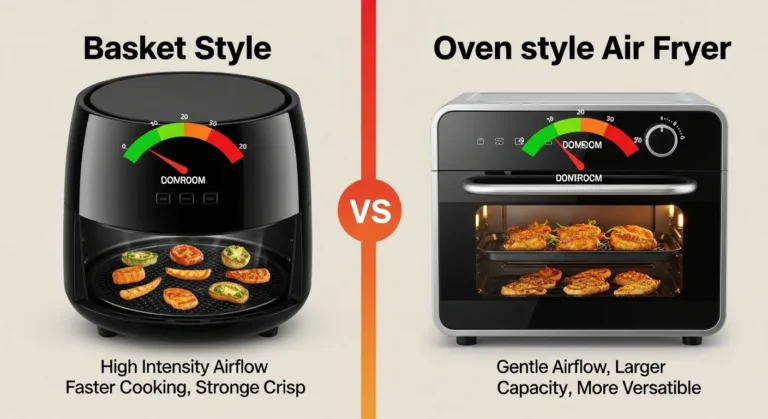
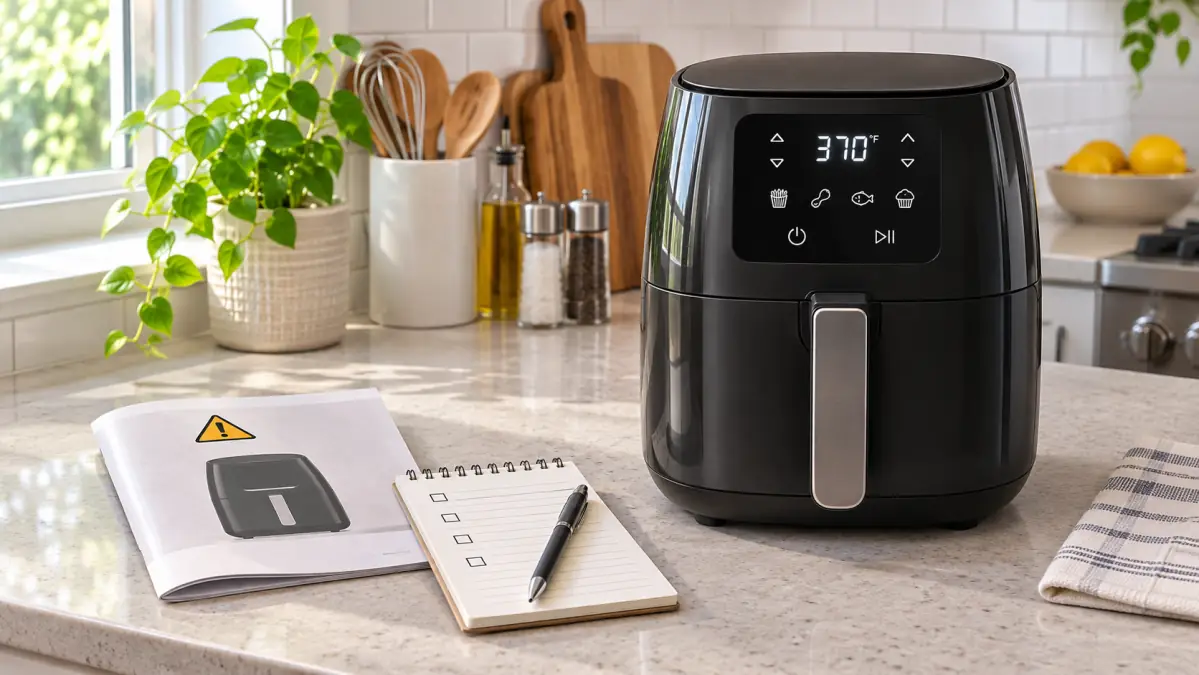
Fryer Bites organized this guide using manufacturer support information, federal safety guidance and our existing symptom-specific articles. It is an educational decision aid, not a hands-on diagnosis of your appliance or a guide to internal electrical repair. The appliance illustrations are AI-generated; the technical diagrams are conceptual.
Before You Troubleshoot: When to Stop Using Your Air Fryer
Stop using the air fryer if you notice sparks, melting, an electrical burning odor, a damaged cord or plug, a hot or discolored outlet, unexplained smoke, or repeated circuit breaker trips. Turn the appliance off and disconnect power only if it is safe to do so. Do not touch a hot, damaged or sparking plug. If there is a fire, get everyone out, stay outside and call 911 in the US. Never pour water on an electrical or grease fire.
Check the US Consumer Product Safety Commission recall database before troubleshooting. If your exact model is affected, stop using it and follow the official remedy. For example, the 2023 COSORI recall notice identified an overheating wire connection in certain models. A recall is not a problem you can clear with a reset.
For household precautions, see the US Fire Administration’s electrical fire safety guidance and home fire escape advice. If you’re unsure whether a symptom is hazardous, stop and ask the manufacturer before using the fryer again.

Air Fryer Troubleshooting Chart
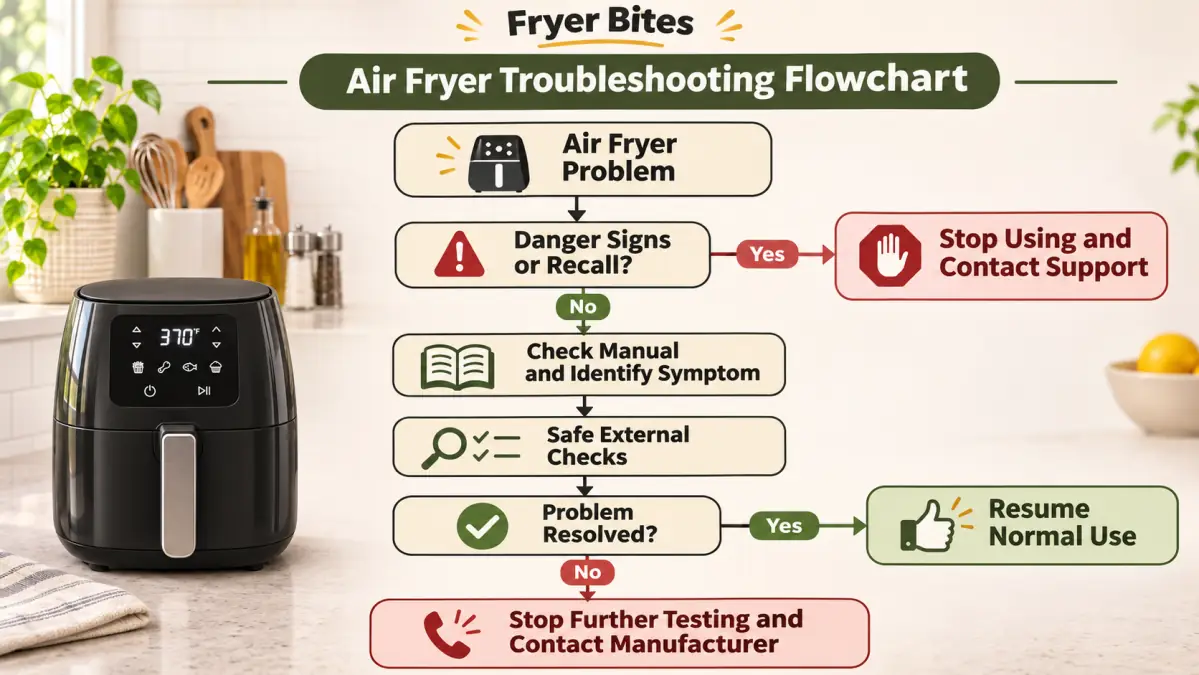
Use this chart as a symptom finder only after ruling out danger signs and matching recalls. Pick the row that describes the problem you actually observed. Follow the exact model manual before attempting any check.
Interactive Air Fryer Symptom Finder
Step 1: Check safety before choosing a symptom.
Stop using the air fryer if you see sparks, melting, a damaged plug or cord, a hot or discolored outlet, unexplained smoke, an electrical burning smell, or repeated breaker trips. If there is a fire, evacuate and call 911 in the US. Disconnect power only when safe.
Check the CPSC recall database for your exact model. If a recall applies, follow its official remedy and do not perform troubleshooting tests.
Yes, there are warning signs, a recall, or I am unsure
Do not continue troubleshooting or restart the appliance. Follow the recall remedy if applicable. Otherwise contact the manufacturer or a qualified electrician, depending on the issue. Do not touch a damaged or sparking plug.
If there is an active fire, leave the area and call emergency services.
No warning signs or matching recall — choose my symptom
Step 2: Open the symptom that best matches your observation. Follow the exact model manual and stop if a warning sign appears.
No power or a blank display
First step: If there are no warning signs, follow your model’s normal start procedure. Check the intact plug is seated in a suitable wall outlet and the drawer is closed as required.
When to stop: If it remains unpowered, stop. Ask an electrician about suspected outlet faults or the manufacturer about appliance faults.
Fan or display works, but there is no heat
First step: Check the selected cooking program, temperature, timer and drawer position against the manual.
When to stop: If normal operation still produces no heat, stop and contact the manufacturer. Do not open the housing.
Unexpected shutdown during cooking
First step: Note whether the timer finished or removing the drawer caused a documented pause.
When to stop: If the shutdown is unexplained, stop using the appliance and contact support. Overheating or breaker trips also require you to stop. Do not restart to reproduce the fault.
Food takes too long to cook
First step: Compare the recipe’s starting temperature, food thickness, load and model-specific settings.
When to stop: If normal loads still cook unusually slowly, contact support instead of extending cooking cycles to compensate for a suspected fault.
Food cooks unevenly
First step: Check portion size, spacing and the manual’s loading limits. Turn food when the instructions permit.
When to stop: If the same area consistently fails to cook normal loads, ask the manufacturer for advice.
Food is soggy instead of crispy
First step: Review surface moisture, basket crowding and recipe preparation. Check safe internal temperatures separately from browning.
When to stop: If the food stays cold or the fryer fails to heat normally, stop using it and contact support.
Smoke or uncertain steam
First step: Stop cooking. If there is any uncertainty about whether you are seeing smoke, stop using the appliance. Only assess accessible parts after it has safely cooled and been unplugged.
When to stop: Unexplained or recurring smoke, sparks or burning odors require discontinuing use. If there is an active fire, evacuate and call 911.
Unusual plastic or burning odor
First step: Stop using the appliance if the odor is unusual or you are unsure. When safely cooled and unplugged, consult the manual for first-use guidance and packaging removal.
When to stop: Melting, electrical odors, strong burning smells or persistent unusual odors require manufacturer advice before reuse.
New grinding, scraping or rattling
First step: Stop the appliance and note the sound. Once safely cool and disconnected, consult the manual for permitted external checks only.
When to stop: If the sound appears internal or the cause is uncertain, contact support. Do not reach the fan or open the housing.
Error code or unusual display
First step: Record the exact message already observed and the complete model number. Consult the official model manual.
When to stop: Follow the documented support procedure. If the error returns or the instructions direct service, stop using the appliance. Do not recreate a hazardous fault.
This educational tool cannot diagnose an electrical fault or certify that an appliance is safe. If you cannot use the expandable controls, the troubleshooting chart immediately below contains the same symptom routes. Choose the stop-use route if you are unsure about safety.
| Symptom | Safe first check | When to escalate |
|---|---|---|
| No power | Check normal power connection and start procedure. | Still dead or outlet damage. |
| Power but no heat | Confirm program, time and temperature. | Heating failure persists. |
| Unexpected shutdown | Check whether timer ended or drawer paused. | Unexplained shutdown or breaker trips. |
| Slow cooking | Review load and recipe settings. | Normal loads still fail to cook. |
| Uneven cooking | Compare piece sizes and spacing. | Problem persists across normal loads. |
| Soggy food | Review moisture and crowding. | Possible heating fault if food stays cold. |
| Smoke | Stop cooking; assess once safe and cool. | Unexplained or recurring smoke. |
| Unusual odor | Stop; check manual and packaging when cool. | Burning, melting or persistent odor. |
| New grinding or rattling | Stop and note the sound. | Unusual noise continues; contact support. |
| Error message | Record the exact code. | Manual directs service or code returns. |
The chart routes you to a next step, not a definite cause. For a cooking problem, adjust one variable at a time. For a possible electrical or mechanical fault, do not run experiments to see how often it fails.
10 Common Air Fryer Problems and What to Do
1. Air Fryer Won’t Turn On
A completely blank display or silent appliance is different from a powered unit waiting for a cooking cycle to begin. With no danger signs, check that the controls are in the normal starting position and that the intact plug is properly seated in a suitable wall outlet. Check that the drawer is closed if the manual requires it. Do not open the electrical housing or use an adapter to force an incompatible plug into an outlet.
If the unit still has no power, stop troubleshooting at home. Suspected outlet faults belong with an electrician; suspected appliance faults belong with manufacturer support.
2. Air Fryer Turns On but Doesn’t Heat
A lit display or running fan alone doesn’t establish that the heater works. Check whether the appliance is in a cooking mode, the temperature is set correctly and the cycle has actually started. A program that pauses with the drawer open may need the drawer properly seated. Check the manual for the correct warm-up sequence.
If a correctly operated appliance still fails to heat, stop and contact support. Don’t remove panels, touch the heater or use improvised tests to determine which component failed.
3. Air Fryer Keeps Turning Off
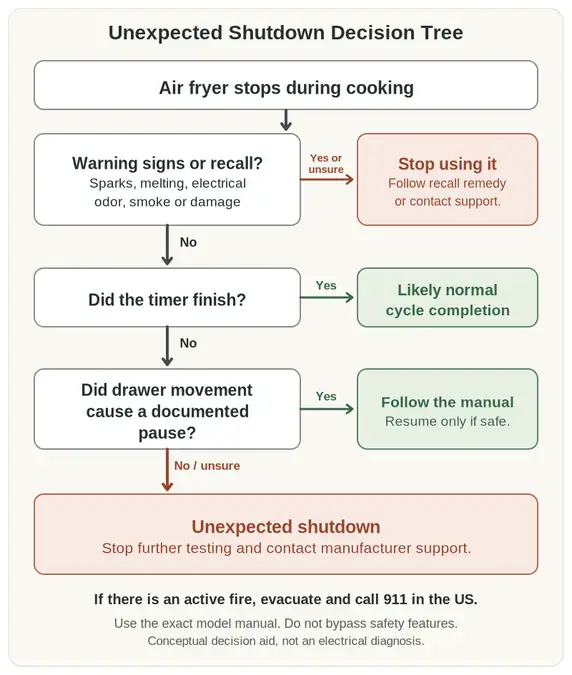
Write down what happened before the interruption. Did the timer reach zero? Did you move the drawer? Did the entire display lose power? These details help separate a normal programmed pause from an unexpected shutdown.
If the interruption is unexplained, or the appliance trips a breaker or appears to overheat, discontinue use and contact support rather than restarting it. Never defeat a drawer switch or overheating protection.
4. Air Fryer Takes Too Long to Cook
Cooking times vary with food thickness, starting temperature, basket size and how much food you add. Check whether your recipe assumes thawed food, a smaller portion or a preheated fryer. Use the instructions for your model, not a generic conversion as a guarantee.
If a normal recipe and normal load still cook unusually slowly, the appliance may need assessment for a heating or airflow problem. Don’t compensate for suspected faults with excessive heat or unusually long cooking cycles.
5. Air Fryer Cooks Food Unevenly
Compare the size and position of pieces in the basket. Large differences in thickness and crowded piles can lead to uneven results. Use the recommended loading limits, arrange the food according to the recipe and turn or redistribute it when the model instructions allow. For example, Philips explains why shaking can improve air circulation around stacked food in applicable models.
If the same area of the basket consistently fails to cook food under normal conditions, consult support. A pattern is useful to report, but it doesn’t prove that the fan or heater is defective.

6. Food Comes Out Soggy Instead of Crispy
Moisture and crowding often matter more than adding extra minutes. Dry fresh ingredients where appropriate, use a small amount of oil if the recipe calls for it and give food enough space for air movement. Follow model-specific warm-up instructions.
Don’t confuse browning with food safety. If food contains meat or poultry, use a thermometer and the federal safe internal temperature chart. If interrupted cooking leaves meat partially cooked, don’t refrigerate it to finish later. If safe completion in another appliance is not possible immediately, discard it.
7. Air Fryer Produces Smoke
Stop cooking if you see smoke. Do not pull out a burning drawer or carry a hot smoking appliance through the house. Once the appliance is safely disconnected and fully cooled, consult the manufacturer for the next step.
For some Philips models, manufacturer smoke guidance identifies accumulated grease and fatty ingredients as possible causes. This is not proof that smoke from another model is harmless. Only clean accessible food-contact parts as directed. If smoke is unexplained, returns, or is accompanied by electrical odors or melting, do not use the fryer again until support has advised you.
8. Air Fryer Smells Like Plastic
A new appliance may have an odor during initial use, but check the exact manual for the expected first-use procedure. When the unit is cool and unplugged, verify that all removable packaging has been taken out and that the washable parts have been prepared as instructed.
A strong burning smell, visible deformation or a sudden new odor from an older machine should never be dismissed as normal. Don’t try to mask an unexplained smell with scented cleaners or additional heating cycles.
9. Air Fryer Makes an Unusual Noise
A steady fan sound and normal timer alerts may be expected. A new scraping, grinding or rattling sound is different. Philips noise guidance distinguishes normal fan noise from sounds that may require service.
Stop the appliance if the sound is new and abnormal. Once it cools, check only the removable accessories you are allowed to handle. If the sound appears to come from inside the housing, contact the manufacturer instead of trying to reach the fan.
10. Air Fryer Displays an Error Code
Record the exact letters, digits or symbols you already observed if it is safe to do so. Do not delay switching off or evacuating to record a code, and do not reproduce a fault. Look up the code using the brand and full model number. Philips error-code support, for example, applies to specified models, not every air fryer.
Follow only the procedure documented for your appliance. A generic E-code list found online may describe a different product. If the manual directs you to service or the error returns, stop using it and ask for help.
Normal Air Fryer Behavior vs Warning Signs
| What you observe | How to interpret it |
|---|---|
| Timer reaches zero | Usually the end of the selected cycle. |
| Cooking pauses when drawer opens | Expected only if described by your model. |
| Steady fan or completion beep | May be part of normal operation. |
| Steam during moist-food cooking | Can be expected; if unsure whether it’s smoke, stop. |
| Unexplained shutdown | Stop use and contact support. |
| Sparks, melted plastic or electrical odor | Stop using immediately; do not test again. |
What matters is a change from the appliance’s documented behavior. If the manual says a fan can continue after cooking, that alone may not be a defect. If the noise, smell or power behavior changes abruptly, treat it differently. A green light on a display does not certify that the appliance is safe.
How to Find Your Air Fryer’s Model Number and Manual
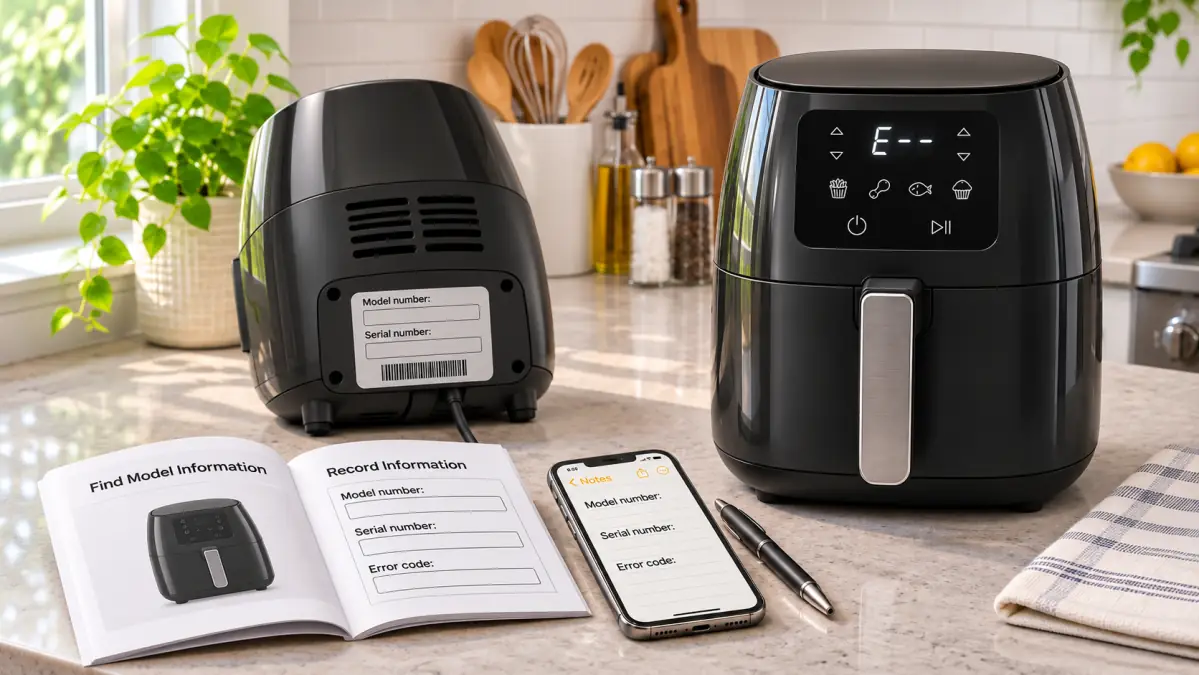
Look for the product rating label, often on the back or base. Unplug the appliance and let it cool completely before moving it. Record the brand, complete model number and any suffix. A model family name or basket capacity is rarely enough to identify an error code or recall.
- Find the manufacturer’s official support page and search by full model number.
- Confirm the instructions match your appliance’s regional version and control layout.
- Check the CPSC recall database and any matching serial or date ranges.
- Record the purchase date, retailer and warranty details.
If you contact support, describe the sequence rather than guessing the broken part. For example: the display went blank three minutes after starting Air Fry with a normal load, and there was no visible damage. Do not include that example as your own observation unless it actually happened.
Should You Repair or Replace Your Air Fryer?
A recall remedy comes first. Otherwise, ask whether your appliance is under warranty and whether the manufacturer offers authorized service. Get the cost and availability of a supported repair before deciding. If a problem involves an outlet or household wiring, have a qualified electrician evaluate that separately.
| Situation | Recommended route |
|---|---|
| Matching safety recall | Follow the official recall remedy. |
| Fault covered by warranty | Contact manufacturer or retailer. |
| Out-of-warranty fault | Ask about authorized repair and parts. |
| Damage with no approved remedy | Keep out of use; consider replacement. |
| Ordinary cooking or loading problem | Use the model manual and adjust the recipe. |
Don’t buy a replacement just because the appliance pauses when the drawer opens. But don’t keep a faulty appliance running to avoid spending money, either. If replacement is appropriate, our beginner air fryer comparison can help you choose controls and capacity that suit your needs.
How to Prevent Common Air Fryer Problems
- Keep air inlets and exhaust outlets clear, with the exact clearances required in your manual.
- Use a suitable wall outlet and don’t run the cooking appliance through an extension cord. Avoid overloading outlets.
- Disconnect power when not in use and before cleaning; let parts cool first.
- Wash removable parts as directed and remove grease or crumbs from accessible areas. Never immerse the electrical unit.
- Respect loading limits and use only permitted accessories. Never leave loose liners where airflow can lift them toward the heater.
- Stay nearby when cooking and stop if the appliance develops unusual symptoms.
Our air fryer cleaning guide covers routine maintenance. Cleaning is preventive care, not a repair for a damaged wire or a failed heater.
Air Fryer Troubleshooting Checklist
Download the free two-page printable worksheet to record safety concerns, check recalls and warranty details, identify your symptom, and prepare information for manufacturer support. Print on US Letter paper (8.5 × 11 inches). Record what already happened instead of restarting a potentially unsafe appliance.
You can also copy the symptom log below if you prefer not to print the PDF.
- Brand and complete model number: ____________________
- Purchase date and warranty status: ____________________
- Recall checked and result: ____________________
- Observed symptom and exact error message: ____________________
- Cooking mode, temperature, load and elapsed time when it happened: ____________________
- Any smoke, odor, abnormal sound, power loss or visible damage: ____________________
- Safe checks already completed (if appropriate): ____________________
- Manufacturer’s advice and support case number: ____________________
Keep the receipt and any existing photographs of the model label or damage for your support case. Don’t power the appliance to create a video of a hazardous fault. If a recall applies, use only the remedy described in the official notice.
Frequently Asked Questions
What should I check first if my air fryer stops working?
First check for signs of danger and recalls. If none are present, read the exact model instructions and identify whether the symptom involves power, heat, the drawer, settings or cooking results.
Can I reset an air fryer that keeps shutting off?
Do not reset an appliance after an unexplained shutdown, a safety warning or a matching recall. Contact support. Only follow a documented reset procedure when it is appropriate for your exact model and the manufacturer confirms it is safe.
Why is my air fryer running but not cooking food?
Incorrect settings, an overloaded basket or a heating problem can produce similar symptoms. Check the model instructions and food load; stop using the appliance if it still fails to heat normally.
Can blocked airflow cause air fryer problems?
Restricted airflow can interfere with cooking and cooling. Follow the model’s loading limits and required external clearances; do not open the housing to inspect the fan.
Is smoke from an air fryer always normal?
No. Stop cooking and assess the cause safely. Unexplained or persistent smoke, electrical odors, melting and sparks require you to discontinue use and seek help.
Can I repair an air fryer heating element myself?
This guide does not recommend internal electrical repairs. Contact the manufacturer for an approved service route or replacement, especially if a safety recall or warranty applies.
The best troubleshooting step is the one that matches the symptom and stays within your appliance’s instructions. Use the chart to find your detailed guide, record the problem and stop when the evidence points beyond ordinary cooking or external checks.