Air Fryer Not Heating Up? 8 Reasons + What to Do

You turn on the air fryer, set the temperature, and expect hot air within a few minutes. Instead, your food stays cold,or the fan runs normally while the cooking chamber never seems to get hot.
An air fryer not heating up does not automatically mean the appliance is finished. A loose drawer, incorrect setting, power problem, or temporary safety shutdown can sometimes create the same symptoms as a failed heater.
Start with the simple checks below before assuming something inside the appliance needs repair.
Quick Check: What Exactly Is Your Air Fryer Doing?
Before changing anything, pay attention to what the appliance is actually doing.
| What you notice | What to check first |
|---|---|
| No display, fan, lights, or sound | Outlet, plug, breaker, power supply |
| Display works but cooking will not start | Drawer position, timer, start button |
| Fan runs but air stays cold | Drawer sensor, settings, heater problem |
| Gets hot and then stops | Cooling, ventilation, overheating |
| Takes much longer than normal | Settings, airflow, buildup, cooking load |
| Shows an error code | Manual/manufacturer instructions |
This distinction matters because an air fryer that has no power at all needs a different troubleshooting path from one whose fan is running normally but producing cold air.
1. The Air Fryer Is Not Getting Proper Power
Start with the outlet.
Even when the appliance looks like the problem, the electrical supply may be the reason it will not start or heat properly.
Unplug the air fryer and inspect the cord and plug. Do not use it if you notice melted plastic, exposed wiring, scorching, loose plug pins, or other visible damage.
Then:
- Plug the air fryer firmly into the wall outlet.
- Test the outlet with another appliance.
- Check whether the kitchen breaker or GFCI outlet has tripped.
- If appropriate for your model, try another properly rated wall outlet.
Avoid repeatedly resetting a breaker that trips every time the air fryer starts. That can indicate an electrical problem that needs attention.
If the display, fan, and controls all work normally, move on to the basket and cooking settings.
2. The Basket or Drawer Is Not Fully Closed
This is one of the easiest things to overlook.
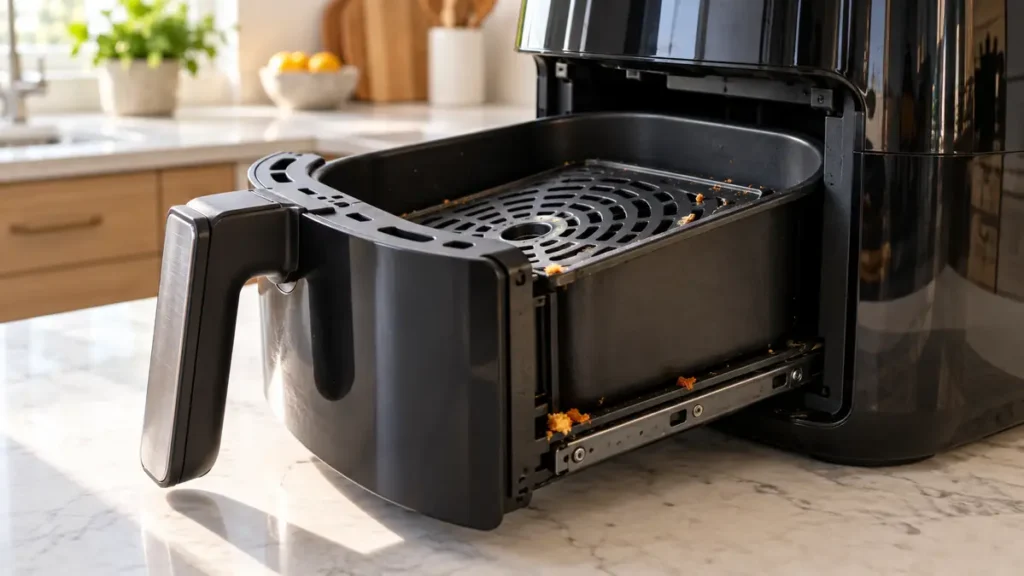
Some air fryers use a safety mechanism that detects whether the basket, pan, or drawer is properly installed. If it is not fully seated, the appliance may prevent normal operation or heating.
Pull the drawer completely out.
Check for:
- Food crumbs around the rails
- A misaligned basket
- A crisper plate sitting incorrectly
- Packaging or liners blocking the drawer
- Damage around the basket or drawer
- Anything preventing it from sliding fully into place
Reinsert everything carefully and push the drawer firmly into its normal cooking position.
Do not tape down, bypass, hold, or modify a safety switch to force the air fryer to run.
If the basket repeatedly refuses to sit correctly, inspect it for visible damage and check the manual for your specific model.
3. The Temperature or Cooking Mode Is Wrong
Sometimes the air fryer is operating exactly as instructed—it just has the wrong instructions.
First, confirm that you actually selected a cooking temperature high enough for the food.
Some models have low-temperature settings for dehydrating, warming, or other specialized functions. On these settings, you may hear the fan without feeling the strong heat you normally associate with air frying.
Philips notes that an air fryer set around 100°F or below may appear as though it is not heating, particularly when the surrounding temperature is similar.
Check:
- Selected temperature
- Cooking function
- Fahrenheit versus Celsius
- Preset selected
- Whether a keep-warm or dehydrating mode is running
If you are unsure how your air fryer normally warms up, our guide to how to preheat an air fryer explains what you should expect during the first few minutes.
4. The Timer or Start Cycle Has Not Actually Begun
An air fryer can appear ready while the actual cooking cycle has not started.
This is especially worth checking on models with manual timer dials.
Make sure you have:
- Selected the cooking function.
- Set the temperature.
- Set a cooking time.
- Pressed Start if your model requires it.
- Confirmed the timer is counting down.
Frigidaire’s troubleshooting instructions specifically include setting the cooking time or selecting a cooking preset when an air fryer will not heat.
If your normal recipes suddenly take far longer than expected even though the fryer does get hot, you may have a different problem. See our guide to fixing incorrect air fryer cooking times for that issue.
5. Overheat Protection Has Temporarily Stopped the Heater
Air fryers generate a lot of heat in a small space.
If the unit becomes too hot, its protective system may interrupt normal operation. What happens next depends on the model.
If the problem occurred immediately after a long cooking session:
- Turn the air fryer off.
- Unplug it.
- Place it on a heat-resistant surface.
- Make sure its air vents are unobstructed.
- Let the appliance cool completely.
- Check your manufacturer’s instructions before restarting it.
Some manufacturer troubleshooting instructions advise unplugging the unit, allowing it to cool, ensuring enough space around it for airflow, and then testing again.
There is an important distinction here.
A temporary thermal protection system may allow the appliance to work normally once it has cooled.
A failed internal thermal fuse or electrical component is different. Do not open the casing or bypass a fuse or safety device to get the appliance running again.

6. Blocked Vents or Grease Buildup Are Causing Problems
Air fryers depend on airflow.
Look around the outside of the unit and make sure the intake and exhaust vents are not pressed against a backsplash, wall, cutting board, towel, or another appliance.
The fryer also needs regular cleaning.
Grease and crumbs can collect around:
- The basket
- Crisper plate
- Drawer
- Interior surfaces
- Accessible area around the heating chamber
Allow the appliance to cool completely and unplug it before cleaning.
Follow your model’s instructions because different air fryers have different removable and washable parts.
Our air fryer cleaning tips cover routine maintenance without turning cleaning into an electrical repair project.
If grease is heavily burned onto areas you cannot safely access, follow the manufacturer instructions rather than dismantling the appliance.
7. A Sensor, Drawer Switch, or Error Code Is Preventing Heating
Modern air fryers can have several protective sensors.
Depending on the model, these may monitor things such as:
- Drawer position
- Pan position
- Temperature
- Overheating
- Control-system errors
An error code is therefore useful information rather than something to ignore.
Write down the exact code and check the manual or official support page for your model number.
Do not assume that an error code from one air fryer brand means the same thing on another.
If your unit repeatedly shows an error immediately after you clear it according to the manufacturer’s instructions, it is usually better to contact the manufacturer rather than repeatedly restarting the appliance.
8. An Internal Heating Component Has Failed
If all the external checks look normal but the air fryer still produces no heat, there may be an internal failure.
Possible components involved can include the:
- Heating element
- Temperature sensor
- Thermal protection component
- Control electronics
- Internal wiring
A useful clue is an air fryer where the display and fan work normally but the air remains completely cold.
That does not prove which internal component has failed. Several faults can create similar symptoms.
For most home users, this is where DIY troubleshooting should stop.
Do not open the appliance while it is plugged in, bypass a thermal fuse, defeat the basket safety switch, or touch internal electrical components.
Check your warranty and contact the manufacturer or a qualified appliance service provider.
Try These Steps in This Order
If you just want a simple troubleshooting sequence, use this:
- Unplug the air fryer.
- Inspect the cord and plug for visible damage.
- Confirm the wall outlet works.
- Remove and correctly reinstall the basket or drawer.
- Check the cooking mode, temperature, and timer.
- Make sure the cooking cycle has actually started.
- Check that exterior vents have enough space.
- If it recently overheated, let it cool completely.
- Clean accessible grease and food residue after it cools.
- Check any displayed error code in your manual.
- Test the appliance again only if it is otherwise safe to operate.
- Contact the manufacturer if the fan runs but no heat returns.
This order helps you eliminate simple problems before concluding that something inside the machine has failed.
Air Fryer Fan Running but No Heat
This symptom deserves special attention because it is confusing.
You may hear what sounds like a completely normal air fryer:
- Fan spinning
- Timer counting down
- Display illuminated
- Buttons responding
Yet the food stays cold.
Start by checking the drawer position and temperature setting.
If those are correct, stop the cycle and let the appliance cool. Check accessible vents and look for an error code.
If the machine repeatedly runs its fan while producing no heat at normal air-frying temperatures, an internal heater, sensor, safety component, or control problem becomes more plausible.
At that point, contact the manufacturer instead of opening the appliance yourself.
What if the Air Fryer Gets Warm but Food Still Does Not Cook?
That is slightly different from an air fryer producing no heat at all.
If it gets warm but meals remain undercooked, consider:
- Overcrowding
- Incorrect temperature
- Very large portions
- A dirty basket
- Blocked airflow
- Starting with very cold or frozen food
- Opening the drawer too often
- Differences between air fryer models
Our guide to getting crispy results in the air fryer can help when the appliance is generating heat but the food is still pale or soggy.
Air fryer capacity can also affect cooking behavior. If you regularly have to pack food tightly into the basket, compare capacities in our air fryer sizes guide.
When You Should Stop Using the Air Fryer
Stop troubleshooting and unplug the appliance if you notice:
- Sparks
- Smoke that appears electrical rather than food-related
- A burning-plastic or electrical odor
- A melted or damaged cord
- A plug that becomes unusually hot
- Visible electrical damage
- Repeated breaker trips
- Loud grinding accompanied by abnormal operation
- Cracked or damaged parts that affect the safety mechanism
Do not keep restarting an appliance showing these symptoms just to see whether the problem disappears.
Safety problems need to be resolved before the air fryer is used again.
Should You Repair or Replace an Air Fryer That Will Not Heat?
Start by checking the warranty.
A relatively new appliance may qualify for manufacturer support, replacement, or repair.
For an older appliance, consider:
- Original purchase price
- Age of the appliance
- Availability of authorized service
- Cost of professional repair
- Condition of the basket and coating
- Whether other problems have started appearing
If a simple external issue caused the problem, replacement obviously is not necessary.
But if the appliance has an internal electrical fault, do not assume opening it yourself is the cheapest option. Safety should matter more than keeping an inexpensive countertop appliance running.
How to Prevent Air Fryer Heating Problems
You cannot prevent every component failure, but good everyday habits can help your air fryer operate normally.
Keep the vents clear
Do not push the appliance tightly against walls or other objects while cooking.
Clean it regularly
Remove grease and crumbs after the unit has cooled.
Avoid forcing the basket
If the drawer does not close normally, find out what is blocking it.
Follow the model’s cooking instructions
Air fryers do not all use identical controls, preheating methods, or safety systems.
Give the unit a break when necessary
Repeated long cooking cycles generate considerable heat. Follow your manual’s recommendations for continuous operation.
Pay attention to changing behavior
A new burning smell, repeated shutdown, unusual noise, damaged cord, or recurring error code deserves attention before the problem gets worse.
Frequently Asked Questions
Why does my air fryer turn on but not heat?
Check that the basket is fully inserted, the temperature and cooking mode are correct, and the timer has actually started. If the fan continues running but the appliance stays cold after those checks, contact the manufacturer because an internal heating component may have failed.
Why is my air fryer fan running but there is no heat?
The fan operating does not necessarily confirm that the heating system is working. Check the drawer position and cooking settings first; if those are correct and the air remains cold, the appliance may need service.
How do I reset an air fryer that is not heating?
For a simple restart, turn the appliance off, unplug it, and allow it to cool before reconnecting it according to the manufacturer’s instructions. A restart will not repair a failed internal heating component.
Can an air fryer stop heating because it overheated?
Yes, some models use protective systems that interrupt normal operation when the appliance becomes too hot. Turn it off, unplug it, make sure the vents are clear, and let it cool before following your model’s restart instructions.
How do I know if my air fryer heating element is broken?
A fan and display that operate normally while the cooking chamber remains completely cold can indicate a heating-system problem, but that symptom alone cannot identify the failed component. Avoid opening the appliance; check the warranty or contact the manufacturer.
Should I replace an air fryer that no longer heats?
Not before checking the outlet, basket position, settings, cooling, and warranty. If an internal electrical failure is confirmed, compare professional repair options with the cost and age of the appliance.
More Relevant Fryer Bites Posts
These related recipes, reviews, and troubleshooting guides may also help: