Air Fryer Size Guide: How to Choose 2QT, 4QT, 5QT or 6QT

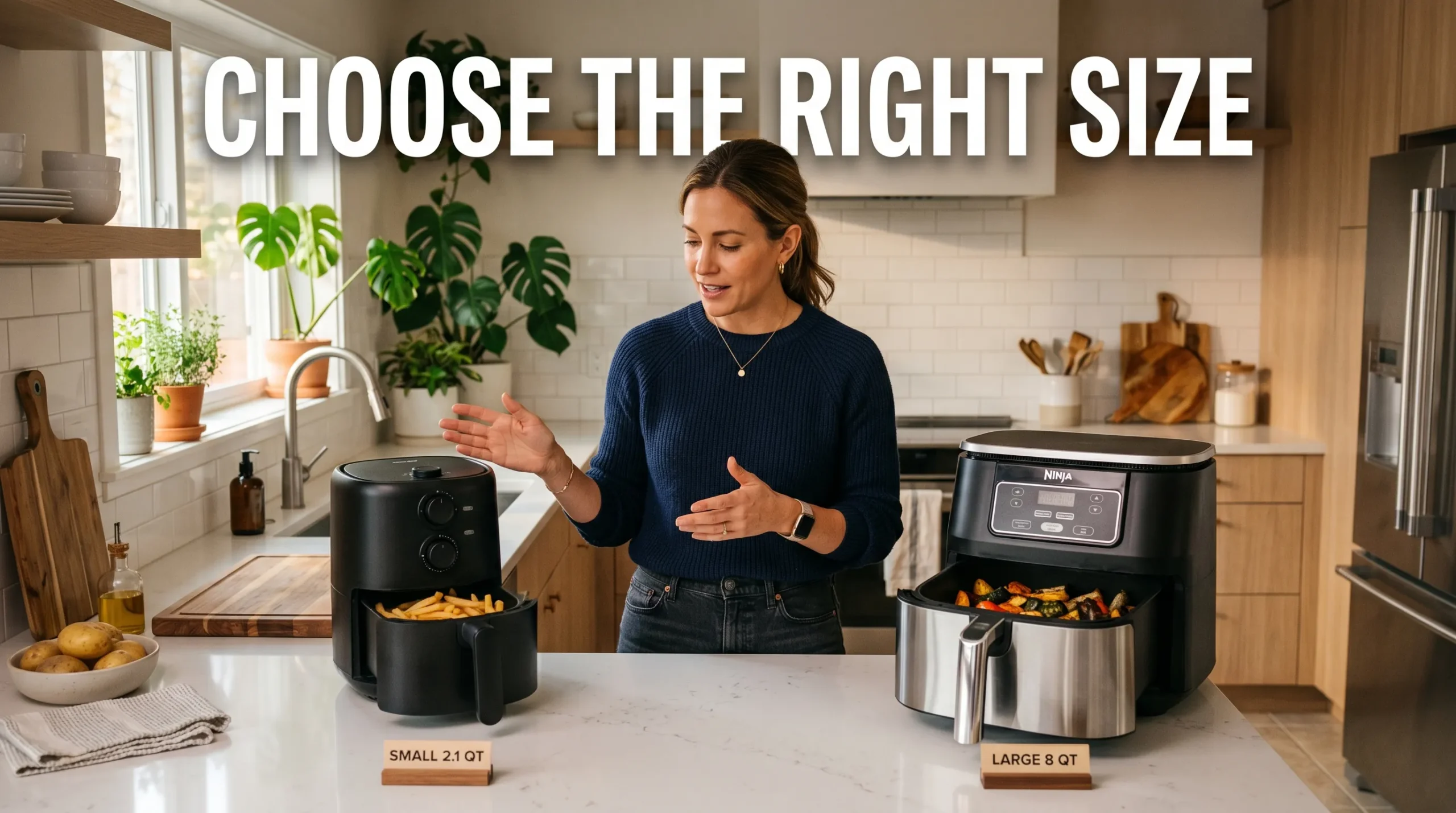
Wondering whether to buy a 2QT, 4QT, 5QT, or 6QT air fryer? If you mostly reheat leftovers and cook small snacks, a compact 2QT model may be enough. For regular meals for one or two, 4QT is worth comparing. If you often cook several portions or want fewer batches, look closely at 5–6QT models. Larger or dual-zone appliances can help when you need separate cooking areas or bigger batches.
But quarts alone won’t tell you what fits. A wide 5QT basket might hold your chicken or fish more comfortably than a tall 6QT basket. Check the usable basket floor, the height of food you cook, how many rounds you can tolerate, and the appliance’s counter footprint before choosing.
This air fryer size guide starts with a quick size-selection table, then compares basket formats, food fit, and 2QT-versus-4QT or 4QT-versus-6QT choices. Use the buying checklist to compare actual models before you choose.
What Air Fryer Size Do You Actually Need?
Use these as starting points, not guaranteed serving counts. Two air fryers with the same quart rating can hold different amounts of food in one layer.
| Size | What to expect |
|---|---|
| 2QT | Works best for one small portion, snacks, or reheating. Limited room for full meals or several protein pieces. |
| 4QT | Worth comparing for meals for one or two. Larger portions or protein plus a side may need a second batch. |
| 5QT | A middle option for everyday meals. Check basket width and shape, not just the one-quart difference. |
| 6QT | Offers more flexibility for multiple portions and fewer batches. Check the counter footprint and usable basket floor. |
| 8QT+ or dual-zone | Consider for larger batches, meal prep, or separate foods. Dual-zone capacity may be split across two drawers. |
For example, if two chicken cutlets must sit flat without overlapping, compare usable basket width and depth rather than relying on a claim that a certain quart size “serves four.” If you’re buying for the first time, use the comparison sections below to narrow the choice.
Why Does Usable Basket Space Matter More Than Quarts?
Air fryer capacity is normally listed in quarts, but quarts describe volume. They do not tell you how much flat cooking surface you have.
That difference matters because many foods air fry best when they have room around them instead of being piled deeply in the basket.
Think about these two hypothetical baskets:
- one is narrow and deep
- one is wide and relatively shallow
They could have similar total volume while behaving very differently when you try to arrange chicken breasts, fish fillets, fries, vegetables, or pizza slices.
Quarts Measure Volume, Not the Shape of Your Meal
A capacity label helps you compare general appliance size, but it doesn’t tell you exactly what will fit.
Before ordering an air fryer, look for:
- basket or crisper-plate width
- basket depth
- usable interior height
- shape of the cooking area
- whether the stated capacity is one basket or divided between multiple zones
If a manufacturer gives only exterior dimensions, check the manual or product documentation for more detail.
Wide vs Deep Air Fryer Baskets
A wider basket is often more useful when you cook foods that need to lie relatively flat.
Think:
- chicken breasts
- cutlets
- fish fillets
- burgers
- vegetables
- fries
- wings
- reheated pizza
A deeper basket can be useful for taller foods, but additional height does not automatically give you more room to spread food across the bottom.
This is why moving from 5QT to 6QT does not always mean you’ll fit dramatically more food in one layer.
Square vs Round Air Fryer Baskets
Basket shape also affects how easily food fits.
A square or rectangular cooking area can make it easier to arrange longer or irregularly shaped pieces. A round basket can still work perfectly well, especially for smaller portions, but the curved edges may affect how certain foods fit.
Don’t choose solely by shape. Compare the actual cooking area of the models you’re considering.
Why Food Height Sometimes Matters More
Flat cooking area isn’t the only consideration.
If you want to cook a whole chicken or another taller item, interior height becomes important too. In that situation, a deeper basket may be more useful than a wider shallow design.
Match the basket to the food you actually plan to cook instead of looking for one basket shape that is supposedly best for everything.
2QT vs 4QT vs 6QT: Which Size Should You Choose?
The number on the box becomes useful only when it helps you solve a real cooking problem: too many batches, food that doesn’t fit flat, or an appliance that’s too large to keep on the counter.
2QT vs 4QT — Is the Compact Size Too Small?
Choose a 2QT air fryer if you’re happy cooking small portions such as a snack, a little frozen food, or leftovers. It can be a good fit when counter or storage space is extremely limited. The drawback appears when you want to cook a main dish and side together or fit two large pieces of protein without overlapping.
A 4QT basket generally gives you more options for regular meals, but capacity labels do not reveal the exact floor dimensions. If you cook dinner rather than occasional snacks, compare the actual 2QT and 4QT basket dimensions and decide how often a second batch would annoy you.
4QT vs 6QT — Is the Extra Space Worth It?
A 4QT model may make sense for one or two people who cook modest portions and don’t mind an occasional second round. A 6QT model is worth the larger footprint when you regularly cook several portions, wider cutlets or fish fillets, or vegetables alongside a main dish.
Don’t expect 6QT to hold exactly 50% more food in one layer than 4QT. The extra volume might come from height, not basket floor area. Compare internal dimensions and what you actually want to arrange side by side.
If you’re leaning toward a 4QT model, browse our 4-quart air fryer recipes for realistic small-basket meal ideas. For specific larger-basket features and model differences, see the Ninja 6-quart comparison. If you want one larger basket rather than two separate zones, the COSORI TurboBlaze is another 6QT option to compare. Before buying, check the exact listed model’s usable basket shape, exterior dimensions, cleaning guidance, and current price. A 6QT label alone does not guarantee fewer batches.
As an Amazon Associate I earn from qualifying purchases.
5QT vs 6QT — What Difference Matters Most?
A 5QT air fryer can be a practical middle ground. If a 5QT model has a broad cooking surface and fits your regular meal, it could be more useful than a narrower 6QT model. Conversely, a 6QT basket that is genuinely wider may reduce cooking rounds.
Compare the basket’s flat area, height clearance, countertop footprint, and how easy it is to clean or store. If neither fits your most common food in one round, decide whether to cook in batches or move up to a different format rather than assuming another quart will solve everything.
What Can You Actually Cook in Each Air Fryer Size?
One of the easiest ways to choose an air fryer is to stop thinking about quarts for a moment and think about dinner.
Write down the three foods you’ll cook most frequently.
Then ask how they need to sit in the basket.
Fries, Nuggets and Wings
These foods can tolerate some movement and tossing during cooking, but packing a large amount into a small basket can make browning and crisping more difficult.
If fries and wings are regular meals rather than occasional snacks, usable basket area deserves more attention.
For texture problems, these tips for getting crispy air fryer results explain why spacing and cooking technique matter.
Chicken Breasts, Cutlets and Fish
Flat pieces make basket width especially important.
A deep basket isn’t much help if the bottom only holds one large chicken breast comfortably and you need to cook several.
Look at the basket dimensions rather than relying on generic “serves four” language.
Vegetables
Vegetables are another case where surface area can be useful.
If you routinely roast enough vegetables to accompany several portions of protein, ask whether your planned basket lets you cook the amount you want without turning one dinner into several separate rounds.
Whole Chicken and Taller Foods
Here, vertical space becomes more important.
Don’t assume that every 5QT or 6QT model fits the same whole chicken. Check the documentation for the exact model and keep required clearance around the food in mind.
Leftovers and Pizza
Reheating is less about total capacity and more about shape.
If pizza slices, sandwiches, or flat leftovers are common, a broad cooking surface may be more valuable than a tall basket with a larger volume number.
Protein Plus a Side
This is where workflow matters.
A large single basket may allow compatible foods to cook together, while a dual-zone appliance can keep foods separate when they need different temperatures or times.
That decision can matter more than moving from one quart number to another.
How Can You Check Whether Your Food Fits Before Buying?
Before ordering an air fryer:
- Choose the largest food you cook regularly.
- Find the usable basket or crisper-plate dimensions for the model you’re considering.
- Think about whether that food needs to lie flat or can be tossed during cooking.
- Decide how much you normally cook at once.
- Ask whether you’d be happy running a second batch.
- Repeat the check for your next two most common foods.
This simple process gives you a better idea of practical capacity than a household-size label alone.
Try a Quick Paper-Cutout Test for Your Usual Dinner
Think of a meal you make often, such as two cutlets and a handful of vegetables. Cut paper shapes roughly the size of the uncooked portions and arrange them with a little space between them. Compare the layout with the usable crisper-plate width and depth of a model you’re considering, not its outer dimensions or advertised quarts.
If the manufacturer doesn’t publish usable cooking dimensions, check the model manual or ask its support team before buying. A picture of a loaded basket or a broad “serves four” claim is not a dependable substitute for the actual space you need.
Should You Buy a Single-Basket, Dual-Basket, or Oven-Style Air Fryer?
Capacity numbers become even harder to compare when you switch air fryer formats.
| Air fryer format | When it helps and what to check |
|---|---|
| Single basket | One cooking chamber is simple for one food or foods with compatible settings. Check usable basket floor space. |
| Dual basket | Two zones can cook foods at different times or temperatures. Advertised capacity is often combined, so check each drawer size. |
| Oven style | Racks or trays can provide more layout options. Check the countertop footprint and airflow differences between rack positions. |
A 10QT dual-basket appliance, for example, does not necessarily give you one continuous 10QT cooking area. Its capacity may be divided into two smaller cooking zones.
That can be excellent when you want chicken in one side and vegetables in the other. It is less helpful if your problem is fitting one large item.
For a deeper format comparison, see basket vs oven-style air fryers.
When Should You Choose an Air Fryer Larger Than 6QT?
An 8QT or larger air fryer can make sense, but bigger should solve a specific problem.
Consider comparing larger models if:
- you strongly dislike cooking in batches
- you regularly prepare several portions at once
- you meal-prep multiple servings
- you frequently cook for guests
- your usual foods need more flat cooking surface
- you want independent cooking zones
- the larger appliance fits comfortably in your kitchen
Do not assume that moving from 6QT to 8QT automatically gives you 33% more useful cooking surface. The extra volume could come from greater basket height, a different shape, or a second cooking drawer.
That is why 8QT belongs in a size discussion, but it shouldn’t automatically be the recommendation for every larger household.
How Much Counter Space Does an Air Fryer Need?
A larger air fryer only saves time if it is convenient enough to use.
Before ordering, measure the area where the appliance will actually sit.
Check:
- overall width
- overall depth
- height beneath cabinets
- room needed to pull the basket fully forward
- room needed to open an oven-style door
- ventilation or clearance requirements in the exact model manual
- cabinet or shelf space if you plan to store it
- whether removable parts will fit comfortably in your sink or dishwasher
Pay special attention to working depth.
An appliance may fit on the countertop while closed but become awkward when you need to pull a large drawer toward you.
Also avoid using a universal clearance number. Follow the instructions for the exact appliance you buy.
Air Fryer Size Buying Checklist
If you’re still deciding between two sizes, use this order:
- List your three most common foods. Start with what you actually expect to cook.
- Decide how many portions you normally make. Use this as context, not as the only sizing rule.
- Decide how you feel about batches. A second cooking round may be fine for occasional use but frustrating at dinner every night.
- Compare usable basket dimensions. Look beyond the quart number.
- Choose one large zone or multiple zones. This separates single-basket from dual-basket needs.
- Measure the kitchen space. Include drawer opening and required clearances.
- Compare exact models. Only after the size and format fit should presets, extra functions, price, and styling make the final decision.
If two models seem equally suitable, the better choice is the one whose usable cooking area and workflow match your normal meals.
Frequently Asked Questions
Is a 4-quart air fryer big enough?
It can be for smaller meals or one or two people, especially when the basket has room for your usual food. A 4QT air fryer isn’t guaranteed to fit any particular number of chicken breasts or a complete family meal. Check the internal dimensions, then explore small-basket recipes for a 4-quart air fryer to see what cooking in that size can look like.
What size air fryer should a family of four compare?
If you often cook four servings together, start by comparing 5–6QT and larger models, including wide-basket and dual-zone options. That is a shortlist, not a promise that everything fits in one round. The right appliance depends on portion size, the foods you make and whether you accept a second batch. Our air fryer model comparison can help once you know your space and format needs.
Is a 2QT air fryer enough for one person?
A 2QT appliance can be enough for small single portions, snacks, and reheating. If you’re preparing full meals with larger proteins or vegetables, a 4QT may be easier to live with. Check your food size rather than assuming one person always needs the smallest machine.
Is 4L the same as 4QT?
No. Four liters equals approximately 4.2 U.S. liquid quarts. A label in liters doesn’t reveal the basket shape or usable cooking floor, so compare the actual interior dimensions as well.
Is an 8QT dual-basket air fryer one large 8QT basket?
Usually not. On many dual-zone models, the listed capacity is the combined volume of two smaller cooking drawers. If you need to cook a large item in one space, check the size of each zone or look for a model with a full-width flexible zone.
Is a bigger air fryer always better?
No. A larger air fryer may reduce batch cooking but can take more counter and storage space. The best purchase is the model whose usable cooking area, loading style and footprint fit the meals you make most often.
The Bottom Line
The best air fryer size isn’t determined by household size alone.
Start with the foods you cook, check how much basket floor they need, decide how much batch cooking you’re willing to do, and then make sure the appliance fits your kitchen. Use the quart number to narrow your search—not to make the final decision.
A well-shaped 5QT model can sometimes suit your meals better than a poorly matched 6QT model, while a larger or dual-zone appliance can be worth the space if it solves a real batch-cooking problem.
Choose the cooking space you’ll actually use.