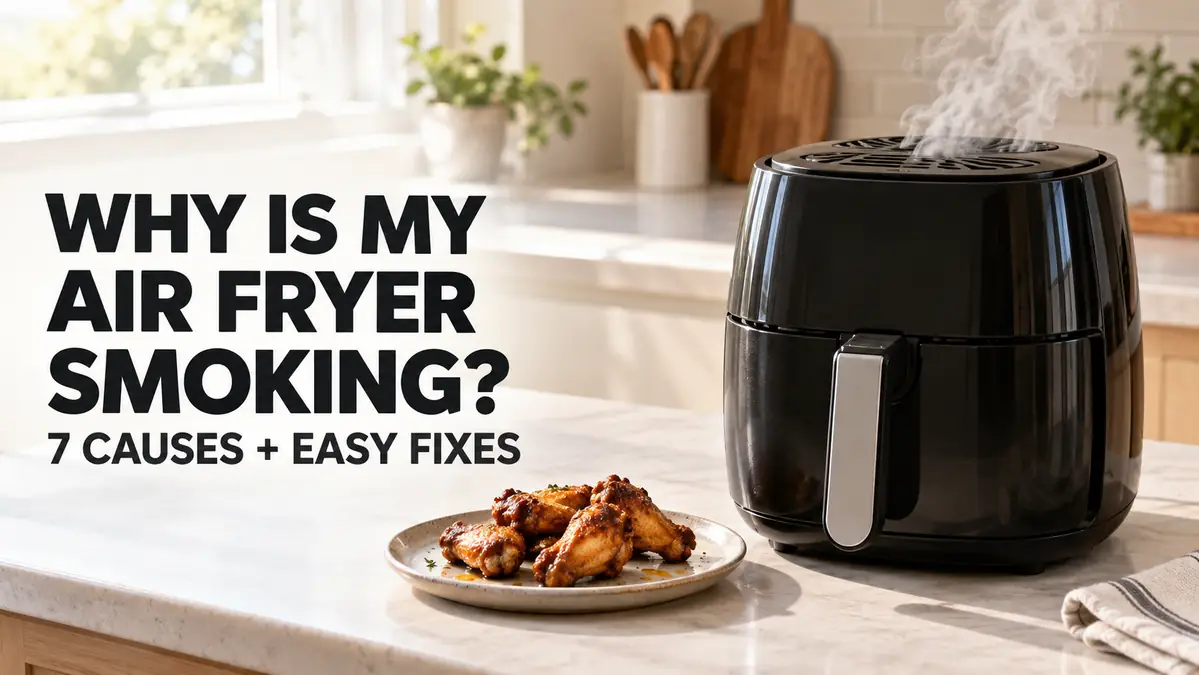
Why Is My Air Fryer Smoking? 7 Causes + How to Fix It

Seeing smoke come out of your air fryer can be alarming, especially when dinner is already halfway cooked.
Fortunately, an air fryer smoking does not automatically mean the appliance is broken.
In many cases, the problem is grease released from fatty food, leftover oil from a previous cooking session, crumbs, excess oil, or something getting too close to the heating element.
Frigidaire lists greasy foods and residue from previous cooking as common causes of white air-fryer smoke, while Philips also identifies loose breading and lightweight ingredients as possible causes.
The first thing to do is determine what kind of smoke you’re seeing and what it smells like.
White smoke while cooking bacon is very different from dark smoke accompanied by a melting-plastic or electrical smell.
Quick Answer: Why Is My Air Fryer Smoking?
The most common reason an air fryer smokes is hot grease.
Fat released from bacon, chicken wings, burgers, sausages, chicken thighs, and similar foods can drip through the basket and collect in the pan below.
Once that grease gets hot enough, it can produce visible white or gray smoke.
Old grease and food residue can create the same problem.
Philips specifically states that high-fat foods and greasy residue left from previous use can produce white smoke.
If your smoke is dark, unusually heavy, or accompanied by an electrical or melting-plastic smell, stop cooking and unplug the appliance rather than treating it as a normal grease problem.
Is It Smoke or Just Steam?
Before troubleshooting, make sure you’re actually seeing smoke.
Air fryers release moisture while cooking.
Frozen foods, vegetables, marinated meat, and foods with high water content can produce visible steam.
Steam usually:
- Looks thin
- Disappears quickly
- Smells like the food being cooked
- Does not leave a strong burnt odor
Smoke normally hangs around longer and may smell greasy, burnt, bitter, or chemical.
If you’re cooking something frozen and see a little vapor around the vent, it may simply be steam.
What Does Air Fryer Smoke Color Mean?
Use this as a quick starting point:
| What You Notice | Possible Cause | What to Do |
|---|---|---|
| Thin vapor that disappears quickly | Moisture/steam | Usually normal |
| White smoke with greasy smell | Rendered fat | Check grease buildup |
| White smoke during preheat | Old oil/residue | Cool and clean |
| Smoke after adding sauce | Sugar or marinade burning | Reduce heat or glaze later |
| Smoke with loose breading | Coating reaching hot areas | Stop and reposition food |
| Dark or heavy smoke | Food/material burning | Stop cooking |
| Electrical/plastic smell | Possible appliance problem | Unplug and inspect |
Philips notes that fatty food, leftover grease, poorly attached breading, and lightweight ingredients can all contribute to smoke.
1. Fatty Foods Are Releasing Too Much Grease
This is the first thing to check.
Foods such as:
- Bacon
- Sausages
- Hamburgers
- Chicken wings
- Chicken thighs
- Fatty pork
- Duck
can release considerable amounts of fat as they cook.
That grease drains through the perforated basket into the lower pan.
Some of it may also splatter onto hotter areas inside the air fryer.
Frigidaire says excessively greasy foods can release oil that produces white smoke during cooking.
How to Fix It
If the smoke becomes excessive:
- Pause the air fryer.
- Let the grease settle.
- Carefully remove the basket according to your model’s instructions.
- Check whether a large amount of fat has collected underneath.
- Safely remove excess grease after the appliance has cooled enough to handle.
Philips recommends stopping cooking and removing excess oil from the pan when high-fat foods generate white smoke.
Avoid pouring water directly onto hot grease.
For future batches, try:
- Cooking smaller quantities
- Draining grease between batches
- Using less added oil
- Choosing slightly leaner cuts where appropriate
2. Old Grease or Food Residue Is Burning
If your air fryer begins smoking during preheating or shortly after turning it on, old residue is a strong possibility.
Tiny crumbs and grease can collect:
- Under the crisper plate
- Around the basket edges
- Inside the drawer
- On upper interior surfaces
- Around the heating area
When the fryer heats again, that leftover residue can begin smoking before fresh food has even started cooking.
Philips and Frigidaire both identify greasy residue from previous use as a common cause of white smoke.
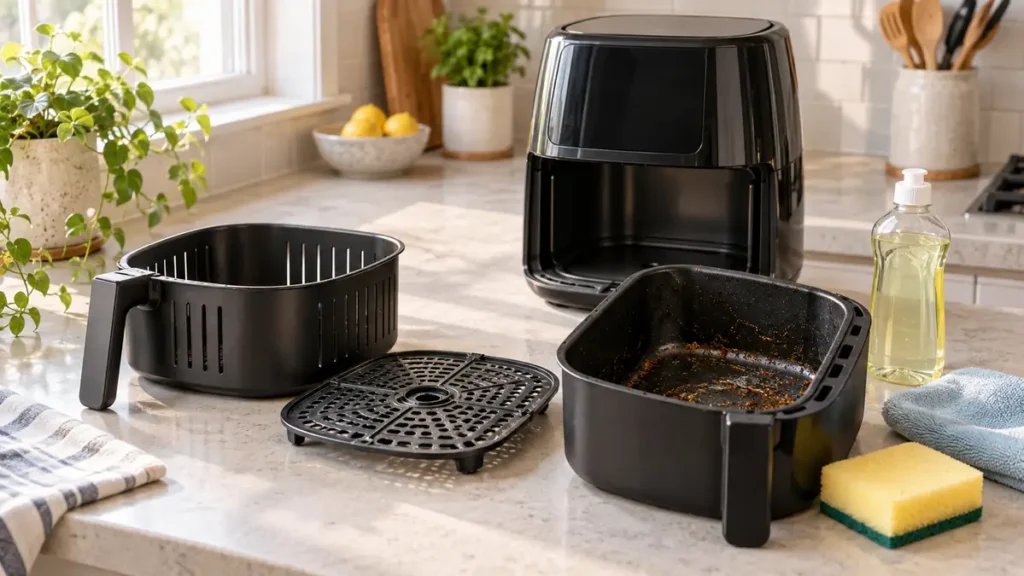
How to Fix It
Unplug the air fryer and allow it to cool completely.
Then clean the:
- Basket
- Crisper plate
- Drawer
- Interior walls
- Accessible upper cooking area
Your existing Air Fryer Cleaning Tips guide is the ideal companion article here.
It explains how grease and carbonized food can accumulate in the basket, pan, and around the heating element and specifically notes that buildup can contribute to smoke and burnt smells.
Avoid metal brushes, steel wool, or harsh abrasive cleaners on nonstick surfaces.
3. You’re Using Too Much Oil
Air frying is not deep frying.
You usually do not need large amounts of oil.
If you coat food heavily with oil, the excess can drip through the basket and collect underneath.
Once the air fryer reaches a high cooking temperature, that oil may start to smoke.
This can be especially unnecessary with foods that already contain oil, including some:
- Frozen fries
- Frozen chicken products
- Breaded snacks
- Pre-seasoned frozen foods
How to Fix It
Use only enough oil to lightly coat the food when oil is actually needed.
For many foods, a small amount is sufficient.
Do not assume that adding more oil will automatically make your food crispier.
Airflow, moisture, cooking temperature, and basket loading matter too.
If you’re adding extra oil because your food isn’t getting crisp, see Why Is My Food Not Crispy in the Air Fryer? instead.
4. Your Oil or Cooking Temperature Is Too High
Sometimes the air fryer itself isn’t the main problem.
The combination of oil and temperature may be.
Different oils behave differently at high temperatures.
And if you’ve converted an oven recipe to the air fryer without adjusting the temperature, you may be exposing the food and oil to more intense heat than necessary.
Air fryers circulate hot air aggressively in a compact cooking chamber.
That means you often don’t need the exact same time and temperature as a conventional oven.
How to Fix It
Try lowering the cooking temperature slightly if:
- Oil begins smoking quickly
- The exterior burns before the center cooks
- Sauces scorch
- Breading darkens too fast
If you’re adapting an oven recipe, use the Oven to Air Fryer Conversion Calculator.
Your Fryer Bites calculator recommends reducing oven temperature and cooking time when adapting recipes because air fryers generally cook food faster in their smaller, high-airflow cooking chamber.
5. Sugary Sauces or Marinades Are Burning
Barbecue sauce, honey, maple syrup, sweet chili sauce, teriyaki-style sauces, and sugary glazes can darken quickly under strong air-fryer heat.
The sugar may begin burning before the center of the food is finished.
Signs include:
- Dark sticky spots
- Bitter smell
- Smoke after sauce is applied
- Burned sauce in the bottom of the basket
How to Fix It
Instead of coating food heavily at the beginning:
- Remove excess marinade
- Cook most of the food first
- Apply sugary glaze toward the end
- Lower the temperature slightly if needed
This lets the meat cook before the sugar is exposed to prolonged high heat.
If food repeatedly burns before it’s finished inside, also review Air Fryer Cooking Times All Wrong? Here’s How to Fix It.
6. Loose Food, Breading, or Parchment Is Reaching the Heating Element
Air fryers move air very quickly.
That’s part of why food becomes crisp.
But strong airflow can also move lightweight materials.
Philips specifically warns that poorly attached breading and lightweight ingredients can be drawn toward the heating element and produce smoke.
Potential troublemakers include:
- Loose breadcrumbs
- Light tortillas
- Thin vegetable chips
- Herbs
- Loose parchment
- Very light slices of bread
How to Fix It
Make sure loose ingredients are properly secured.
Press breading firmly onto food.
Follow your air fryer’s instructions for parchment and liners.
One particularly important mistake is placing loose parchment inside an empty air fryer during preheating.
Your own How to Preheat an Air Fryer guide already warns against leaving parchment or liners inside while preheating because they can move around and interfere with airflow.
Add liners only when your model permits them and when food can safely hold them in place.
7. The Smoke May Be Coming From the Appliance Itself
This is the situation to treat differently.
Normal cooking smoke usually smells like:
- Grease
- Burned food
- Overcooked sauce
More concerning signs include:
- Strong electrical smell
- Melting-plastic smell
- Sparks
- Visible melted material
- Damaged cord
- Smoke coming from the controls or base
- Smoke continuing with a clean, empty appliance
What to Do
Turn off the appliance.
Unplug it.
Allow it to cool.
Do not repeatedly turn it back on just to test whether the problem happens again.
Inspect for:
- Packaging accidentally left inside
- Melted accessories
- Damage to removable parts
- Cord or plug damage
- Unusual scorching
If the source appears electrical rather than food-related, consult your manufacturer’s support or service instructions before using it again.
Why Is My Air Fryer Smoking When Cooking Bacon?
Bacon is one of the foods most likely to make an air fryer smoke because it releases a large amount of fat.
The grease falls underneath the basket and continues heating.
If you cook several batches without removing accumulated grease, smoke may become progressively worse.
Try:
- Smaller batches
- Draining grease between batches
- Slightly lower cooking temperature if appropriate
- Cleaning the drawer afterward
White smoke from fatty food is specifically recognized by manufacturers as a common air-fryer behavior.
Why Is My Air Fryer Smoking When Cooking Chicken Wings?
Chicken wings contain skin and fat.
As they cook, fat renders into the drawer.
Adding a heavy coating of oil can make the problem worse.
For wings, concentrate more on airflow than excess oil.
Avoid packing the basket too tightly.
If you’re routinely struggling to fit food without stacking it heavily, your air fryer may simply be too small for the quantity you’re preparing.
See the Air Fryer Sizes Guide: 2QT–6QT for help matching basket capacity to cooking needs.
Why Is My Air Fryer Smoking During Preheating?
If there is no food in the basket yet, fresh food cannot be releasing grease.
That immediately shifts suspicion toward:
- Old grease
- Crumbs
- Burnt sauce
- Residue around the basket
- Residue near the heating area
Let the unit cool and clean it thoroughly.
If the air fryer is completely clean and still repeatedly smokes while empty, stop treating it as a normal food problem.
Consult the manufacturer’s troubleshooting guidance.
Why Is My New Air Fryer Smoking?
Some appliances may produce a small amount of smoke during the initial use.
Philips states in one of its Airfryer manuals that some smoke during first use can occur.
However, always follow the first-use instructions for your specific model.
Usually that includes:
- Removing all packaging
- Washing removable components
- Wiping the interior
- Checking that nothing remains around the heating area
Persistent heavy smoke, melting smells, or visible damage should not simply be assumed to be normal first-use behavior.
How to Stop an Air Fryer From Smoking
Your fix should match the cause.
If fatty food is causing it
Remove accumulated grease safely and consider smaller batches.
If old grease is causing it
Deep clean the basket, drawer, and accessible cooking chamber.
If excess oil is causing it
Reduce the amount used.
If sauce is burning
Apply sugary sauce later in the cook.
If breading is moving around
Press it firmly onto the food.
If parchment is lifting
Stop cooking and follow the manufacturer’s liner instructions.
If smoke smells electrical
Unplug the appliance and stop using it until the cause is identified.
How to Prevent Air Fryer Smoke
A few habits can prevent most smoke problems.
Clean the basket after greasy meals.
Empty crumbs.
Do not allow layers of oil to remain in the drawer.
Inspect the upper cooking chamber occasionally.
Avoid excessive oil.
Use an appropriate basket load.
Keep loose materials away from the heating area.
Follow the correct cooking temperature.
Your Air Fryer Cleaning Tips guide already recommends cleaning the basket after each use and periodically checking interior surfaces and the heating area for grease.
When Should You Stop Using a Smoking Air Fryer?
Stop cooking and investigate further if you notice:
- Dark or unusually heavy smoke
- Sparks
- Electrical smell
- Strong melting-plastic smell
- Damaged plug or cord
- Melted components
- Smoke coming from the control area
- Repeated smoke from a thoroughly cleaned empty air fryer
A little grease smoke from bacon is one situation.
Smoke that appears to originate from electrical components is another.
When the source is not clearly food or residue, don’t keep running the appliance hoping it clears itself.
Frequently Asked Questions
Is it normal for an air fryer to smoke?
Light white smoke can occur when cooking high-fat foods or when leftover grease becomes hot. Frigidaire and Philips both identify fat and grease residue as common causes of white smoke.
Why is white smoke coming out of my air fryer?
The most common causes are fat released from food, old oil or grease inside the pan, loose breading, or lightweight ingredients moving toward the heating element.
Why does my air fryer smoke when I cook bacon?
Bacon releases considerable fat while cooking. That grease can collect beneath the basket and become hot enough to smoke.
Can too much oil cause an air fryer to smoke?
Yes. Excess oil can drip through the basket and collect in the pan, where continued high heat may cause it to smoke.
Why does my air fryer smoke when there is no food in it?
If smoke begins during empty preheating, look for old grease, crumbs, burnt sauce, or residue left from previous cooking.
Can parchment paper cause an air fryer to smoke?
Loose parchment can move because of the powerful fan and may get too close to the heating element. Always follow your manufacturer’s liner instructions and avoid loose parchment during empty preheating.
Why does my air fryer smell burnt?
Burnt-food smells often come from grease, crumbs, sauce, or food residue. A strong electrical or melting-plastic smell deserves more caution; unplug the appliance and identify the source before using it again.
Final Thoughts
If your air fryer is smoking, start with the simplest explanation.
Check the grease.
Fatty foods and old residue are among the most common causes of white smoke.
Then look at how much oil you’re using, whether sauce is burning, and whether loose ingredients or liners are moving toward the heating area.
And pay attention to the smell.
Ordinary grease smoke and an electrical burning smell are not the same problem.
Once you learn to distinguish steam, grease smoke, burnt food, and abnormal appliance smoke, troubleshooting becomes much easier and most everyday smoking problems can be prevented with better cleaning, airflow, and cooking habits.
More Relevant Fryer Bites Posts
These related recipes, reviews, and troubleshooting guides may also help: