Are Air Fryers Toxic? What the Evidence Actually Says

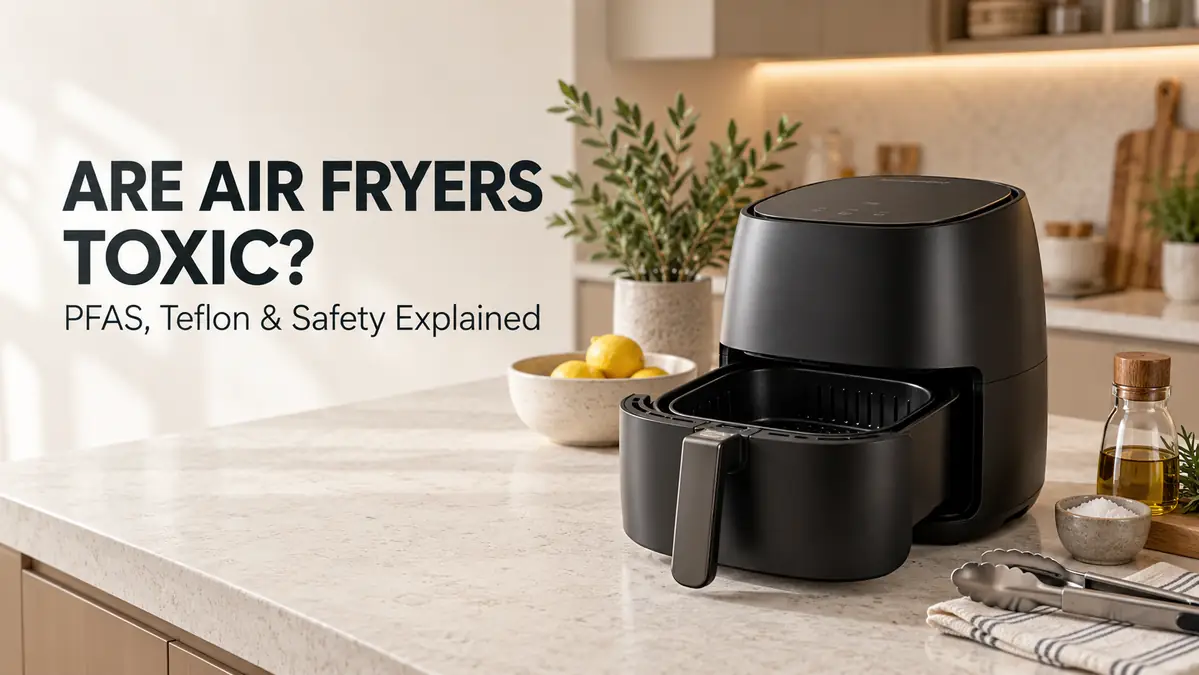
Air fryers are not inherently toxic when used as intended. The concerns people usually mean when they ask whether air fryers are toxic involve nonstick coatings such as PTFE, the broader PFAS chemical family, scratched or peeling baskets, plastic odors, and acrylamide that can form when certain foods become heavily browned.
Those issues are not all the same.
An intact nonstick coating, a badly deteriorated basket, a malfunctioning appliance, and very dark air-fried potatoes involve different questions and different types of risk.
For most people, the practical question is simpler:
Is there anything about my air fryer right now that means I should change how I use it or stop using it?
This post contains affiliate links.

Ninja DZ201 Foodi 8-Quart Dual Basket Air Fryer
- Two independent baskets: cook a main and a side at once
- Fits a family-size meal in one go
- Easy-clean, dishwasher-safe baskets
As an Amazon Associate I earn from qualifying purchases.
Should You Keep Using Your Air Fryer?
Use this table as a quick starting point.
| What You Notice | What It Means | What to Do |
|---|---|---|
| Intact nonstick basket | Normal intended use is different from severe overheating or coating failure | Follow the manual and protect the surface |
| One small scratch | Does not mean the basket suddenly became poisonous | Avoid further abrasion and monitor the surface |
| Widespread peeling or flaking | The cooking surface is deteriorating | Replace the basket or contact the manufacturer |
| Bubbling or blistering coating | Surface is no longer in normal condition | Stop using that basket and seek replacement guidance |
| PFOA-free label | Does not tell you whether PTFE or other PFAS are present | Check the full material specification |
| Ceramic label | Does not automatically tell you the complete coating chemistry | Look for explicit PFAS-free or PTFE-free wording if that matters to you |
| Temporary first-use odor | May be related to manufacturing or packaging, but procedures vary by model | Follow the manufacturer’s first-use and cleaning instructions |
| Melting, warping, smoke, or electrical/burning odor | Possible appliance or component problem | Unplug it and contact the manufacturer |
| Very dark fries or toast | Heavy browning can increase acrylamide in some starchy foods | Aim for golden rather than very dark brown |
This is more useful than treating every concern as proof that the entire category of air fryers is unsafe.
What Does “Toxic” Mean When People Talk About Air Fryers?
The word toxic is often used to describe several different concerns at once.
1. Food-contact materials
This includes questions about:
- PTFE nonstick coatings
- PFAS
- ceramic coatings
- plastic components
- scratched or deteriorating baskets
The important questions are what material actually touches the food, what condition it is in, and how the appliance is being used.
2. Compounds created during cooking
Acrylamide is the main example.
It can form when some starchy plant foods are cooked at high temperatures and become browned. This is a cooking chemistry issue, not a chemical leaking from the air fryer basket.
3. An appliance that is damaged or malfunctioning
Melting plastic, a damaged power cord, uncontrolled overheating, smoke from electrical components, or obvious warping is different from ordinary questions about an intact cooking surface.
A useful way to think about chemical risk is that hazard and exposure are not the same thing. A chemical can have hazardous properties, but the actual risk also depends on whether and how much of it reaches you during a specific use.
That distinction matters when discussing PFAS.
PFAS vs. PTFE vs. PFOA: What’s the Difference?
These terms are often used as if they mean exactly the same thing. They don’t.
| Term | What It Means |
|---|---|
| PFAS | A very large family of fluorinated chemicals |
| PTFE | A fluoropolymer widely used to create nonstick cooking surfaces |
| PFOA | One specific chemical within the wider PFAS family |
| Teflon | A well-known trademark associated with PTFE products |
PTFE is generally included within broad definitions of PFAS, but it behaves very differently from small PFAS molecules that may be found in drinking water or environmental contamination.
That is why a general statement such as “PFAS can have health effects” does not by itself tell you how much exposure occurs from an intact polymerized cookware coating.
Does PFOA-Free Mean PFAS-Free?
No. A PFOA-free air fryer is not automatically PFAS-free.
PFOA is only one member of the much larger PFAS family.
A product can therefore be marketed as PFOA-free while still using a PTFE nonstick coating.
If your goal is specifically to avoid the broader PFAS category, look for more precise information about the actual food-contact surfaces.
Air Fryer Coating Label Decoder
| Label | What It Tells You | What It Doesn’t Prove |
|---|---|---|
| PFOA-free | The manufacturer is saying PFOA isn’t used/present as claimed | Does not automatically mean PTFE-free or PFAS-free |
| PTFE-free | The product does not use PTFE as claimed | Does not identify every material or coating ingredient |
| PFAS-free | A broader claim than PFOA-free | Check whether it applies specifically to food-contact parts |
| Ceramic-coated | Identifies a general coating category | “Ceramic” alone doesn’t fully describe the formulation |
| Bare stainless steel | Food contacts stainless steel on that stated surface | Other trays or accessories may use different materials |
| Glass cooking vessel | The glass itself has no conventional nonstick coating | Other removable parts may contain different materials |
| Non-toxic coating | Marketing description | Does not tell you exactly what the coating is made from |
When material avoidance is important to you, specific material disclosures are more useful than broad marketing terms.
Are PTFE Air Fryer Baskets Safe During Normal Use?
Current food-contact and risk-assessment guidance does not support the idea that an intact PTFE cooking surface automatically poisons food during normal intended use.
PTFE nonstick coatings are highly polymerized. During manufacturing, the coating is bonded to the cookware surface.
Available food-contact data indicate that only negligible amounts of the relevant polymerized PFAS are capable of migrating from properly manufactured nonstick coatings into food.
That does not erase every environmental concern surrounding PFAS as a broad chemical family.
It means that exposure from an intact polymerized cookware coating should not be treated as identical to exposure from PFAS in contaminated drinking water, industrial pollution, or other sources.
Can an Air Fryer Overheat PTFE?
PTFE becomes a concern when it is severely overheated.
Current cookware risk guidance identifies decomposition at roughly 360°C, or about 680°F, where potentially harmful gases can be released.
Normal air-fryer cooking temperatures are typically far below that figure.
However, that doesn’t mean overheating is impossible under every failure scenario. The more useful advice is to use the appliance as designed:
- stay within its stated operating range
- don’t modify the temperature controls
- keep ventilation openings clear
- follow the manufacturer’s instructions
- stop using the appliance if it severely overheats or malfunctions
The condition of the appliance matters as much as the temperature shown on the display.
Is a Scratched Air Fryer Basket Toxic?
A small scratch in a PTFE surface is not evidence that your food has suddenly become toxic.
Current risk-assessment guidance indicates that accidentally swallowing tiny PTFE particles from a scratched surface is not expected to cause health effects because PTFE is chemically inert and is not digested in the normal way.
That does not mean basket damage should be ignored.
Small cosmetic scratch
If the coating has one minor mark but is otherwise intact:
- avoid metal utensils
- avoid abrasive scrubbers
- follow the manufacturer’s care instructions
- monitor the area for further deterioration
Peeling, flaking, bubbling, or blistering
This is different.
Consider replacing the basket or contacting the manufacturer when:
- coating repeatedly flakes off
- large areas are peeling
- the surface bubbles or blisters
- substantial bare metal is exposed
- the coating separates from the basket
- damage continues getting worse
The reason isn’t that one flake proves poisoning. It’s that a badly deteriorated cooking surface is no longer in the condition the appliance was designed to use.
Proper cleaning can help prevent premature coating damage. See our guide on how to clean an air fryer without damaging the basket.
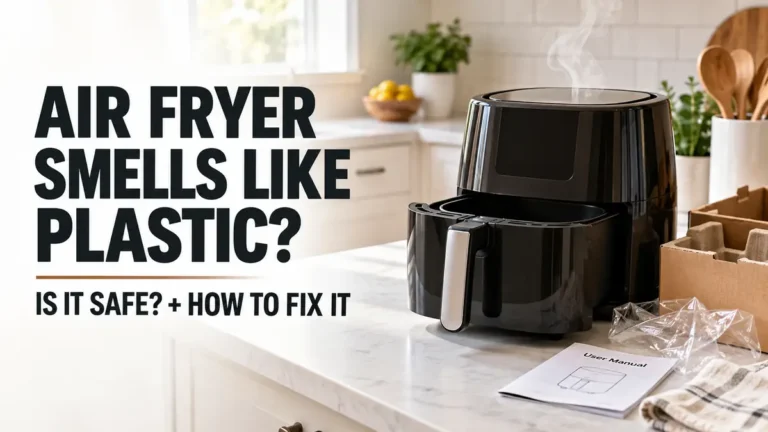
My Air Fryer Smells Like Plastic — Should I Stop Using It?
A new appliance can sometimes have an odor during its first uses, but there is no universal rule that every plastic or chemical smell should simply be ignored.
Start with the manual for your specific model.
Before first use:
- remove all packaging and protective materials
- check for film, tape, inserts, and labels that are meant to be removed
- wash removable cooking parts as directed
- follow any manufacturer-specific first-use procedure
- make sure nothing is touching the heating element that shouldn’t be there
Avoid inventing your own extreme-temperature “burn-off” procedure unless the manufacturer specifically recommends it.
A smell becomes more concerning when it is accompanied by:
- visible melting
- warped plastic
- electrical or burning-wire odor
- smoke from the appliance itself
- malfunctioning controls
- repeated abnormal overheating
- a persistent strong odor that doesn’t match the manufacturer’s guidance
If any of those occur, unplug the air fryer and contact the manufacturer rather than continuing to experiment with it.
Can Air Fryers Create Acrylamide?
Yes. Air-fried food can contain acrylamide, but the air fryer is not unique in creating it.
Acrylamide can form naturally in some carbohydrate-rich plant foods during high-temperature cooking.
Common examples include:
- potatoes
- bread
- crackers
- grain products
- coffee beans during roasting
Frying, roasting, baking, and air frying can all create conditions where acrylamide forms.
The useful distinction is:
Acrylamide is produced by reactions in certain foods during browning. It is not simply a chemical released by the air fryer appliance.
Does Air Frying Produce Less Acrylamide Than Deep Frying?
Not consistently.
You may see claims that switching from deep frying to air frying automatically produces dramatically less acrylamide.
The research is more complicated.
Some comparisons have found lower acrylamide with air frying, while others have found higher amounts. European food-safety reviews have cited testing where hot-air fryers produced 30–40% more acrylamide than conventional deep-oil fryers.
A controlled potato study published in 2024 also measured the highest average acrylamide concentration in its air-fried potatoes compared with deep- and oven-fried samples.
Importantly, the differences between those cooking methods in that study were not statistically significant.
So the evidence does not support either extreme:
- “air frying always reduces acrylamide”
- “air frying always creates more acrylamide”
Food type, potato variety, preparation, temperature, cooking duration, and final degree of browning can all affect the result.
How to Reduce Acrylamide When Air Frying Potatoes and Bread
You don’t need to eliminate every browned food from your diet.
A practical approach is to avoid unnecessarily dark browning.
1. Aim for golden, not dark brown
For potatoes, stop cooking when they are golden yellow rather than deeply browned or burned.
The darker portions generally contain more acrylamide.
2. Don’t cook longer than necessary
Longer cooking and higher temperatures can increase acrylamide formation.
More heat isn’t automatically better.
If recipes frequently overcook in your appliance, these air fryer cooking-time adjustments can help you account for differences between machines.
3. Soak fresh-cut potatoes when appropriate
Soaking raw potato slices in water for about 15–30 minutes before frying or roasting can reduce acrylamide formation.
Drain and dry the potatoes well before air frying.
4. Store raw potatoes appropriately
Keeping potatoes in the refrigerator can increase the sugars that contribute to acrylamide formation during high-temperature cooking.
For potatoes you’re planning to fry or roast, a cool, dark storage area outside the refrigerator is generally preferred.
5. Keep toast lighter
The same principle applies to bread: light brown toast generally contains less acrylamide than very dark toast.
Do Air Fryers Cause Cancer?
There is no evidence that simply owning or normally using an air fryer has been shown to cause cancer.
Most cancer discussion around air fryers eventually comes back to acrylamide.
High doses of acrylamide have caused cancer in laboratory animals. However, human dietary research has not produced consistent evidence that acrylamide consumed in food is associated with an increased risk of any specific type of cancer.
That doesn’t mean acrylamide should be ignored.
It means the statement “air fryers cause cancer” goes well beyond what human evidence currently supports.
Reducing excessive browning of starchy foods is a reasonable precaution without turning ordinary air-fryer use into a cancer scare.
Do Air Fryers Use Harmful Radiation?
Air fryers do not cook food with microwave energy or ionizing radiation.
They operate primarily through:
- an electric heating element
- a high-speed fan
- circulating hot air
That makes the cooking method closer to a compact convection oven.
Like any hot object, an air fryer and its heating element emit ordinary thermal energy, including infrared radiation. That’s very different from the kind of ionizing radiation people usually mean when they worry about radiation causing DNA damage.
If you want a clearer explanation of the mechanism, see how an air fryer actually works.
What If You Want to Avoid PFAS Completely?
You don’t have to believe your current air fryer is poisoning you to decide that you’d rather avoid PFAS in future cookware.
That’s a personal material preference.
Look for clearly documented food-contact surfaces such as:
- explicitly PFAS-free ceramic coating
- explicitly PTFE-free coating
- bare stainless steel
- glass cooking vessels
Don’t stop at a vague phrase such as “healthy coating” or “non-toxic.”
Also check more than the main basket. A model may use one material for the rack and another for the crisper tray or removable accessories.
For a detailed material and product comparison, see our guide to glass, ceramic, and stainless steel air fryers.
7 Practical Ways to Use an Air Fryer More Safely
1. Follow the manual for your exact model
Clearance requirements, accessories, maximum temperatures, cleaning procedures, and first-use instructions can vary.
2. Keep the exhaust area clear
Air fryers move very hot air.
Don’t push the rear vent directly against:
- a wall
- power cords
- paper
- plastic packaging
- other heat-sensitive objects
3. Protect nonstick surfaces
For coated baskets, avoid tools and cleaners that can scratch the surface.
Use the utensil types recommended by the appliance manufacturer.
4. Replace badly deteriorated components
Repeated peeling, blistering, melting, or serious physical damage deserves more attention than a tiny cosmetic scratch.
Check whether the manufacturer offers a replacement basket before replacing the entire appliance.
5. Keep grease and crumbs under control
Old food residue and accumulated grease can smoke and create odors.
Regular cleaning also makes it easier to notice actual basket damage.
6. Use only suitable accessories
Don’t assume every container belongs inside an air fryer.
A product being:
- microwave-safe
- freezer-safe
- dishwasher-safe
doesn’t automatically mean it is suitable for air-fryer temperatures.
Foil also needs to be used correctly so it doesn’t obstruct airflow or contact the heating element. See our guide to using foil in an air fryer safely.
7. Don’t burn food unnecessarily
Very dark browning isn’t required for crisp results.
For starchy foods in particular, aim for a crisp golden finish rather than pushing them toward dark brown or burned.
Frequently Asked Questions
Are all air fryer baskets coated with PFAS?
No. Food-contact materials vary by model. Some use PTFE nonstick coatings, while others use ceramic coatings, stainless steel, glass, or combinations of different materials.
Is a ceramic air fryer automatically PFAS-free?
No. The word “ceramic” by itself does not tell you everything about a coating’s composition. If avoiding PFAS matters to you, look for an explicit PFAS-free or PTFE-free statement from the manufacturer.
Does PFOA-free mean Teflon-free?
No. A PFOA-free product may still use PTFE.
Is one scratch enough to throw away an air fryer?
Not automatically. A tiny scratch does not prove toxic exposure, but worsening scratches, repeated peeling, blistering, or widespread coating damage are reasons to consider replacing the basket.
Should I stop using an air fryer basket that’s peeling?
A basket with substantial peeling or flaking should be replaced or evaluated by the manufacturer because the cooking surface is deteriorating and is no longer in its intended condition.
Why does my new air fryer smell like plastic?
First check that all packaging has been removed and follow the manufacturer’s cleaning and first-use instructions. If the odor remains strong or is accompanied by melting, warping, electrical smell, smoke, or malfunction, stop using the appliance and contact the manufacturer.
Are stainless steel or glass air fryers safer?
Bare stainless steel and glass avoid a conventional PTFE coating on those specific food-contact surfaces. That does not automatically make every stainless steel or glass appliance “safer overall,” because safety also depends on the complete appliance design, materials, condition, and proper use.
Are Air Fryers Toxic? Bottom Line
Air fryers are not inherently toxic when they’re used as intended.
For a typical intact appliance, the most useful things to check are what material actually touches your food, whether the cooking surface is still in good condition, and whether the appliance is operating normally.
If your air fryer uses PTFE, current evidence does not support treating normal intended use as automatic toxic exposure. Severe overheating is different, and a badly deteriorated basket should be replaced rather than ignored.
Acrylamide is a separate food-browning issue. It can form during several high-temperature cooking methods, not just air frying, and air frying does not guarantee lower levels. Aim for golden rather than burned starchy foods and avoid cooking longer or hotter than needed.
And if you simply prefer to avoid PFAS in your cookware, look for clearly documented PFAS-free, PTFE-free, stainless steel, or glass food-contact surfaces rather than relying on vague marketing language.