Ceramic Air Fryer Guide: Materials, Coatings & Buying Tips

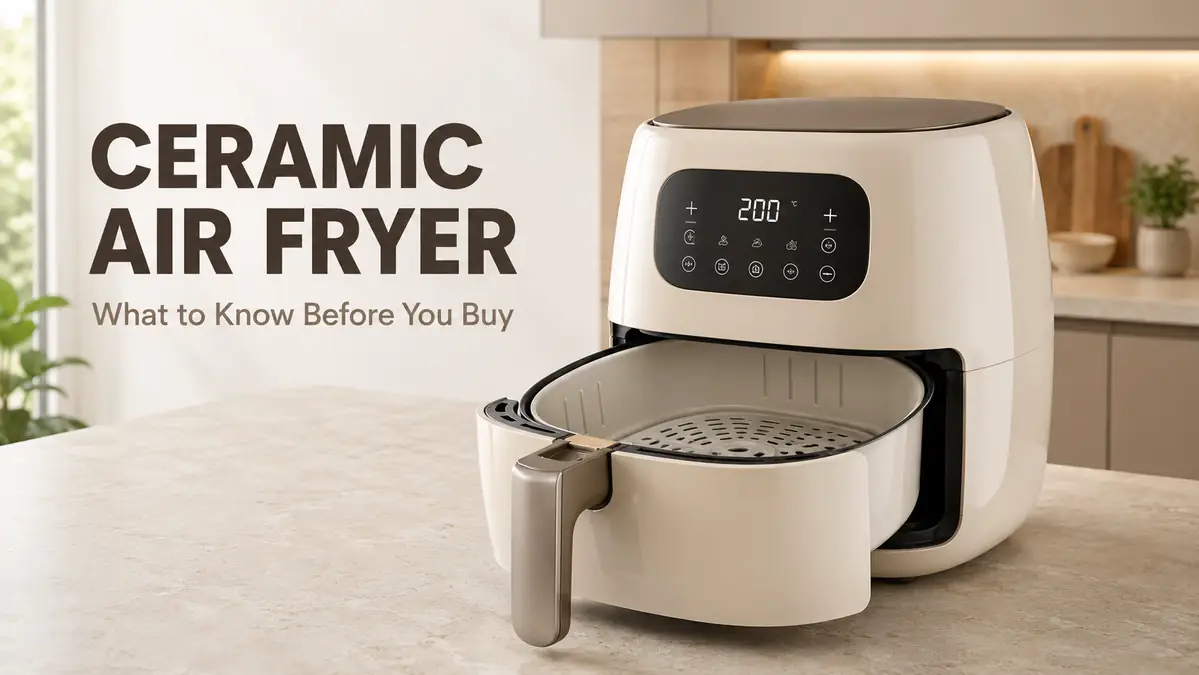
A ceramic air fryer can sound like an appliance made from ceramic, but that usually is not what the term means. In most cases, the basket, crisper plate, tray, or another cooking surface is made from metal and finished with a ceramic-style coating.
That distinction matters because two air fryers can both be advertised as ceramic while using different coatings, different basket materials, and different care instructions. Some manufacturers also make specific PFAS-free or PTFE-free claims for certain models, while others provide much less detail.
If you are comparing ceramic air fryers, do not choose based on the word “ceramic” alone. Look at exactly which parts are coated, the manufacturer’s material disclosure, basket capacity, cleaning instructions, replacement-part availability, and whether the appliance format actually suits the way you cook.
This post contains affiliate links.
Ninja DZ201 Foodi 8-Quart Dual Basket Air Fryer
- Two independent baskets: cook a main and a side at once
- Fits a family-size meal in one go
- Easy-clean, dishwasher-safe baskets
As an Amazon Associate I earn from qualifying purchases.
What Should You Consider Before Buying a Ceramic Air Fryer?
What Part of the Air Fryer Is Actually Ceramic?
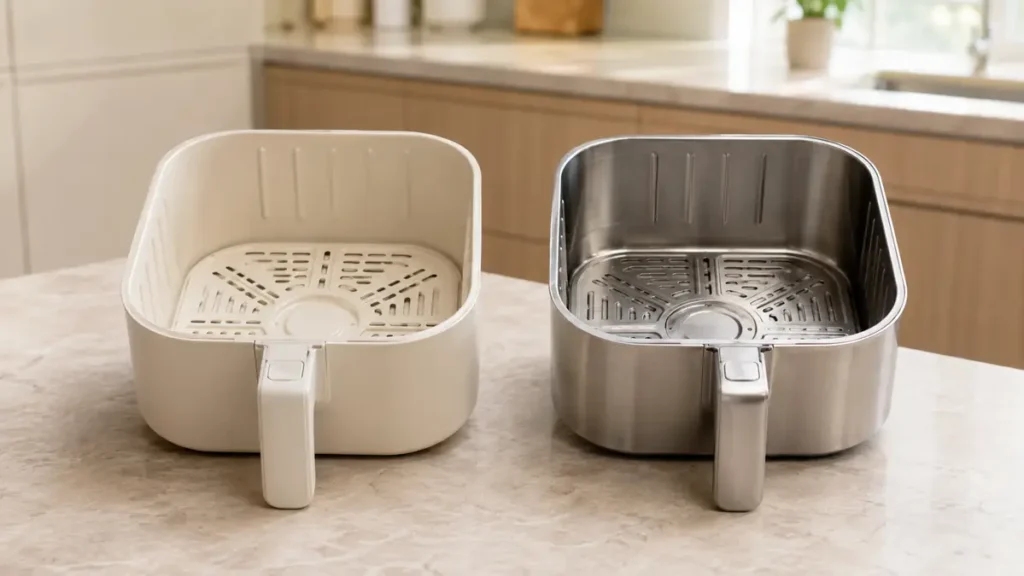
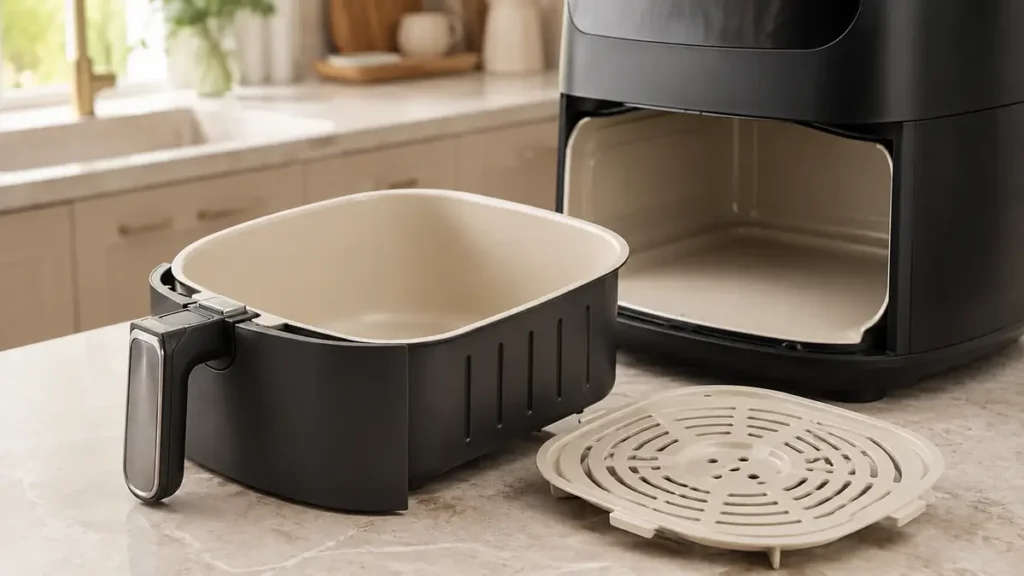
Most ceramic air fryers are not made from solid ceramic. The term generally refers to a ceramic-coated cooking surface applied over another material, commonly metal.
The coating may appear on the:
- main cooking basket
- removable crisper plate
- air fryer tray
- oven-style cooking accessories
- other food-contact cooking surfaces
Read the product specifications carefully because the presence of one ceramic-coated component does not necessarily mean every food-contact surface uses the same coating.
Does Ceramic Automatically Mean PFAS Free?
No. The word ceramic by itself should not be treated as proof that an air fryer is PFAS-free or PTFE-free.
Those terms describe different things. “Ceramic-coated” describes the type of cooking surface, while PFAS-free or PTFE-free are specific material claims that should come from the manufacturer for the exact product.
When comparing models, look for clear wording rather than assuming one claim from another.
- Ceramic-coated: describes a coated cooking surface.
- PTFE-free: indicates that the manufacturer says PTFE is not used in the specified product or surface.
- PFAS-free: is a broader material claim and should be verified for the exact model.
- PFOA-free: does not automatically tell you whether other PFAS substances are present.
A good buying decision starts with the model number and manufacturer documentation, not broad marketing phrases such as “clean,” “natural,” or “non-toxic.”
How Much Capacity Do You Need?
Material is only one part of choosing an air fryer. A ceramic-coated basket that is too small for your normal meals will still be frustrating to use.
Think about how much food you usually prepare at once and whether you are comfortable cooking in batches.
For help matching appliance capacity to household needs, see our air fryer sizes guide.
Are Replacement Baskets Available?
This is one of the most overlooked factors when buying a coated air fryer.
The basket and crisper plate receive constant heat, washing, utensil contact, and food abrasion. If one of these surfaces eventually becomes damaged, having an official replacement available can be much more practical than replacing the entire appliance.
Before buying, search the manufacturer’s accessory section for:
- replacement baskets
- replacement crisper plates
- cooking trays
- racks
- other food-contact accessories
What Does the Warranty Cover?
Do not look only at the length of the appliance warranty. Check whether removable baskets, trays, coatings, and other accessories are covered under the same terms.
Warranty conditions differ by manufacturer, so review the policy for the exact model before buying rather than assuming every coated cooking part receives the same coverage.
What Types of Ceramic Air Fryers Are Available?
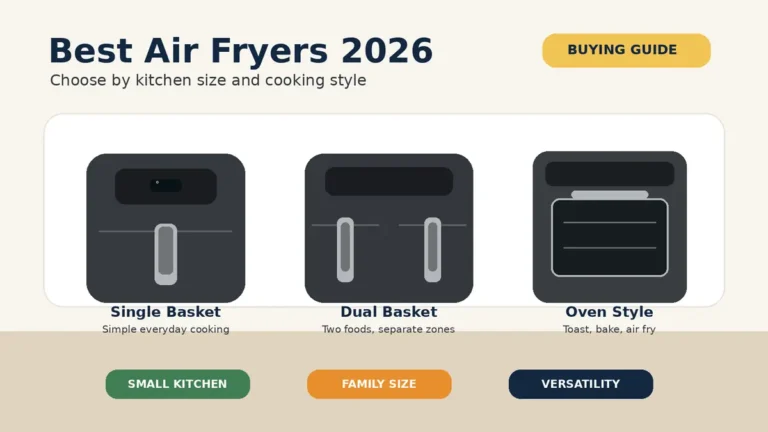
Single-Basket Ceramic Air Fryers
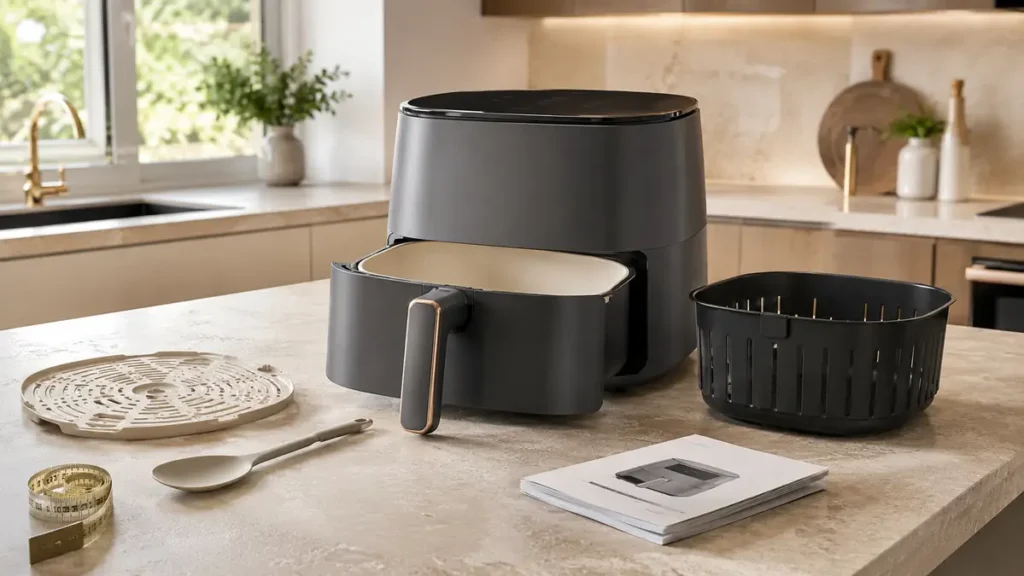
Single-basket models are the simplest format. They usually have one pull-out drawer with a basket or removable crisper plate inside.
They make sense for everyday foods such as vegetables, chicken, fries, frozen snacks, and smaller meals.
Before buying, confirm whether both the basket and removable plate use the ceramic coating or only one component does.
Dual-Basket Ceramic Air Fryers
Dual-basket air fryers provide two separate cooking zones. They can be useful when preparing a protein and side that need different times or temperatures.
If coating material is your priority, check both cooking zones. Do not assume that a product described as ceramic-coated uses the same surface on every removable component.
Oven-Style Ceramic Air Fryers
Oven-style air fryers use racks, trays, or mesh baskets instead of a traditional drawer.
They can provide more flexibility for pizza, toast, larger portions, roasting, and baking, but they also take up more counter space and have more surfaces to clean.
If you are unsure which appliance format fits your cooking style, our air fryer basket vs oven-style comparison explains the practical differences.
Multifunction Ovens With Ceramic Accessories
Some countertop ovens include ceramic-coated trays or accessories while the rest of the cooking chamber uses other materials.
This is another reason to read the full material description instead of relying only on the product headline.
Which Ceramic Air Fryer Features Matter Most?
Clear Material Disclosure
The product page should tell you which food-contact parts are ceramic-coated and provide any specific PFAS, PTFE, or related material claims.
If the wording is vague, look for the manual, technical specifications, or manufacturer support information before buying.
Removable Crisper Plate
A removable crisper plate makes it easier to reach grease and food residue underneath the cooking surface.
Because the plate is also handled and washed frequently, check whether a replacement is sold separately.
Dishwasher-Safe Parts
Do not assume every ceramic air fryer basket is dishwasher safe.
Some manufacturers permit dishwasher cleaning for removable parts, while others recommend hand washing. Follow the instructions for your exact model rather than using one universal cleaning rule.
Utensil Compatibility
Coated surfaces can be vulnerable to scratching. Check whether the manufacturer recommends silicone, nylon, wooden, or other utensils and whether metal utensils are specifically restricted.
Using the correct utensils is especially important if preserving the coating is one of your main reasons for choosing ceramic.
Temperature Range
Compare the actual temperature range if you regularly cook foods that need higher or lower settings.
A higher maximum temperature is not automatically better. What matters is whether the range suits the foods you cook.
Basket Shape
Capacity numbers do not tell the whole story. A wider basket can sometimes be more useful than a narrow, deep basket because more food can sit in one layer.
This can improve airflow and reduce the need for multiple batches.
Viewing Window
A clear viewing window can be convenient because you can check browning without repeatedly opening the basket.
It is useful, but it should rank below cooking-surface material, basket size, replacement parts, and cleaning instructions when comparing models.
Cooking Presets
Presets are convenient, but a longer list of buttons does not automatically make an air fryer better.
Prioritize:
- Cooking surface and material disclosure
- Capacity
- Air fryer format
- Replacement parts
- Cleaning requirements
- Then additional presets
How Much Does a Ceramic Air Fryer Cost?
Ceramic-coated air fryers are available across several price levels. Prices change frequently, so it is more useful to compare features and product tiers than to rely on temporary sale prices.
Budget Models
Lower-priced ceramic air fryers tend to offer smaller capacity, simpler controls, and fewer additional features.
At this level, focus particularly on how clearly the manufacturer identifies the coating and whether replacement parts are available.
Mid-Range Models
Mid-range models may add larger baskets, digital displays, more cooking programs, viewing windows, or better accessory packages.
Do not assume the higher price automatically means a more durable ceramic coating. Check the warranty and care instructions.
Premium Models
Premium ceramic air fryers may include dual cooking zones, oven-style layouts, larger capacity, advanced controls, or multiple cooking accessories.
Pay extra for features you will actually use rather than choosing the model with the longest feature list.
Common Mistakes When Buying a Ceramic Air Fryer
Assuming the Whole Appliance Is Ceramic
Usually it is not. Identify the exact ceramic-coated food-contact components.
Assuming Ceramic Means PFAS Free
Do not make this assumption from the word ceramic alone. Look for an explicit manufacturer statement for the exact model.
Trusting Marketing Language Instead of Specifications
Terms such as “healthy,” “clean,” “eco,” or “non-toxic” are less useful than specific material information.
Look for actual coating disclosures and product documentation.
Ignoring Replacement Parts
A replacement crisper plate may matter more after several years than an extra preset that you rarely use.
Choosing the Wrong Capacity
A small air fryer can create constant batch cooking, while an oversized model can take up unnecessary counter space.
Using Abrasive Cleaning Tools
Rough scrubbers or cleaning methods not approved for the coating can damage the cooking surface.
For general routine care, see our air fryer cleaning tips, while still following the instructions supplied with your specific appliance.
Assuming Dishwasher Safe Means Every Cleaning Method Is Fine
If a basket is dishwasher safe, that tells you one approved cleaning option. It does not mean every abrasive cleaner, scrubber, or utensil is suitable for the coating.
Ceramic vs Stainless Steel vs Traditional Nonstick Air Fryers
| Feature | Ceramic Coated | Stainless Steel | Traditional Nonstick |
|---|---|---|---|
| Surface | Coated cooking surface | Uncoated metal | Coated cooking surface |
| Food release | Usually easy when coating is performing well | May require more oil or cooking technique | Usually easy when coating is performing well |
| Coating wear | Possible | No nonstick coating to wear | Possible |
| Scratch concerns | Yes | Lower coating-related concern | Yes |
| Cleaning | Often straightforward | May require more scrubbing | Often straightforward |
| Material claims | Verify exact model | No nonstick coating on the steel surface | Verify exact coating |
| Replacement basket importance | High | Moderate | High |
| Best suited to | Buyers wanting coated easy-release surfaces with specific material disclosures | Buyers preferring an uncoated cooking surface | Buyers prioritizing conventional nonstick convenience |
Is Ceramic Better Than Stainless Steel?
Neither material is automatically better for every buyer.
Ceramic-coated surfaces can provide convenient food release and easier cleanup when the coating is in good condition. Stainless steel avoids a nonstick coating that can wear, but food may stick more easily and cleanup can require more effort.
Choose based on the surface characteristics you prefer, the manufacturer’s material disclosure, and how much maintenance you are comfortable with.
How Durable Is Ceramic Air Fryer Coating?
There is no reliable universal lifespan for ceramic air fryer coating.
Durability depends on several factors:
- coating formulation
- frequency of use
- utensils
- washing method
- abrasive cleaning
- dishwasher exposure when applicable
- heat exposure
- how often removable parts are handled
Signs of Coating Wear
Possible signs include reduced food release, visible scratches, rough areas, discoloration, or obvious peeling or flaking.
Normal staining and actual coating damage are not always the same thing, so consult the manufacturer if you are unsure what you are seeing.
What Should You Do if the Ceramic Coating Starts Peeling?
Do not attempt a homemade recoating repair.
Check the manufacturer’s care instructions, warranty, and replacement basket or tray options. If the food-contact surface is visibly damaged, contact the manufacturer for model-specific guidance rather than improvising a repair.
How to Clean a Ceramic Air Fryer
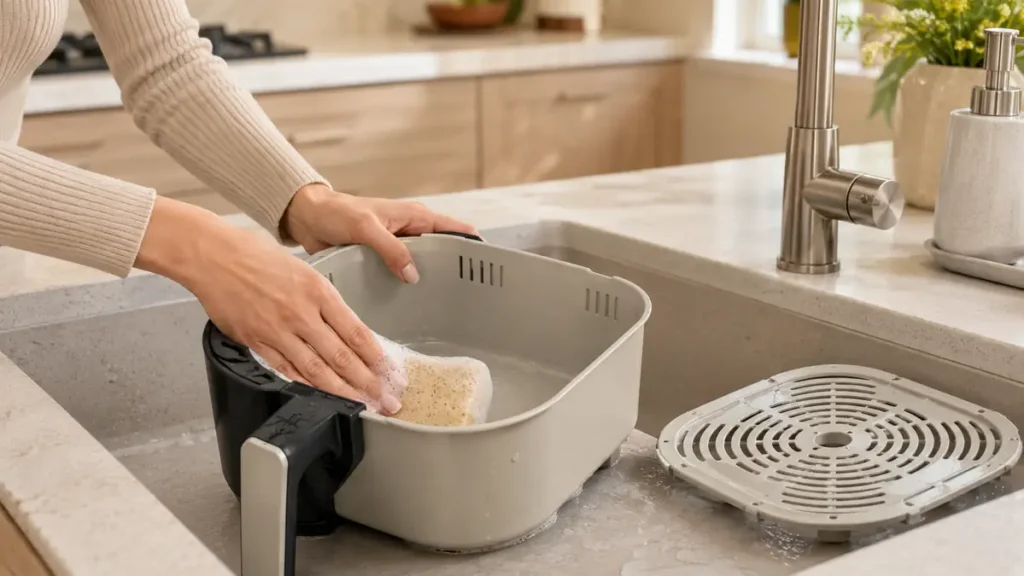
Always start with the care instructions for the exact model because ceramic-coated components are not all maintained in exactly the same way.
- Turn off and unplug the air fryer.
- Allow the appliance and removable components to cool.
- Remove the basket, tray, or crisper plate.
- Wash the components using the method approved by the manufacturer.
- Use non-abrasive cleaning tools when required.
- Remove grease and food residue before it becomes heavily baked onto the surface.
- Dry the components thoroughly before reassembling the appliance.
If the manual says the parts are dishwasher safe, follow those instructions. If it recommends hand washing, do not assume dishwasher cleaning is interchangeable.
7 Things to Check Before Buying a Ceramic Air Fryer
- Which parts are actually ceramic-coated? Check the basket, crisper plate, tray, and other food-contact surfaces.
- What material claims does the exact model make? Look specifically for PFAS, PTFE, or other coating disclosures rather than assuming them from the word ceramic.
- Is the basket large enough? Choose a capacity that fits your normal meals without constant batch cooking.
- Is it basket or oven style? Pick the format that suits the foods you cook most often.
- Can you buy replacement cooking parts? Look for official baskets, trays, and crisper plates.
- How does the manufacturer say to clean it? Confirm dishwasher, hand-washing, and utensil guidance.
- What does the warranty cover? Check whether coating and removable accessories are treated differently from the main appliance.
This checklist is more useful than choosing solely by the number of presets or the word ceramic printed on the product page.
Frequently Asked Questions
What is a ceramic air fryer?
A ceramic air fryer is generally an air fryer that uses a ceramic-style coating on one or more food-contact cooking surfaces, such as the basket, crisper plate, or tray. The entire appliance is usually not made from ceramic. Check the exact product specifications to see which components use the coating.
Are ceramic air fryers actually made of ceramic?
Usually not. Most ceramic air fryers use a ceramic-based coating applied over a metal basket, tray, or crisper plate. Different products may coat different components, so the term ceramic air fryer should not be interpreted as meaning that the entire cooking chamber or appliance is made from solid ceramic.
Are ceramic air fryers PFAS free?
Not automatically. Some manufacturers explicitly state that specific ceramic-coated models are PFAS-free, while the word ceramic alone does not prove that claim. Check the material disclosure for the exact model you are considering rather than assuming every ceramic-coated air fryer uses the same coating chemistry.
Is ceramic the same as PTFE free?
No. Ceramic describes a type of cooking surface or coating, while PTFE-free is a specific material claim. A product should be considered PTFE-free only when the manufacturer provides that information for the exact model or cooking surface rather than because the product is simply marketed as ceramic.
Is ceramic better than stainless steel in an air fryer?
It depends on your priorities. Ceramic-coated surfaces generally provide easier food release and convenient cleanup when the coating is in good condition. Stainless steel has no nonstick coating to wear, but food may stick more easily. Neither material is automatically the best option for every kitchen.
Does ceramic air fryer coating scratch?
Yes, ceramic-coated cooking surfaces can become scratched depending on the utensils, cleaning tools, and care methods used. Follow the manufacturer’s utensil and washing instructions. Avoid assuming that a tool is safe for the coating simply because it has worked on another air fryer or piece of cookware.
How long does ceramic air fryer coating last?
There is no universal lifespan for ceramic air fryer coating. Durability depends on the coating formulation, frequency of use, utensils, washing method, heat exposure, and how the removable components are handled. Replacement-part availability and warranty terms are therefore important factors when choosing a ceramic air fryer.
Can ceramic air fryer baskets go in the dishwasher?
Some can and some cannot. Dishwasher compatibility varies by model, even among ceramic-coated air fryers. Check the manual or manufacturer instructions for the exact basket and crisper plate. If the manufacturer recommends hand washing, follow that guidance rather than assuming all ceramic-coated parts are dishwasher safe.
Can I use metal utensils on a ceramic air fryer basket?
Use only utensils approved by the manufacturer for your exact cooking surface. Many coated cooking products recommend silicone, nylon, or wooden utensils to reduce scratching. Do not assume metal utensils are safe unless the manufacturer specifically says the coating is designed to tolerate them.
What should I do if the ceramic coating starts peeling?
Do not attempt to repaint or recoat the cooking surface yourself. Check the manufacturer’s care instructions, warranty, and replacement basket or tray options. If the coating is visibly damaged, contact the manufacturer for guidance specific to that model and cooking component.
Is a ceramic air fryer worth it?
A ceramic air fryer can be worth considering if you want an easy-release coated cooking surface and the exact model provides the material disclosure, basket capacity, cleaning requirements, and replacement parts you want. Do not choose based on the ceramic label alone; compare the complete appliance and its long-term maintenance needs.
Final Thoughts
A ceramic air fryer can be a practical choice, but the word ceramic should be the beginning of your research rather than the final buying decision. Two ceramic-coated models can differ significantly in materials, size, care instructions, accessories, and replacement-part support.
Before buying, verify exactly which surfaces are ceramic-coated, read the manufacturer’s PFAS or PTFE information when that matters to you, measure the capacity and countertop space, and check how the basket should be cleaned. That gives you a much clearer picture of whether a particular ceramic air fryer fits your kitchen.
More Relevant Fryer Bites Posts
These related recipes, reviews, and guides may also help: