Quick & Easy 30-Minute Weeknight Meals: A 5-Day Dinner Plan

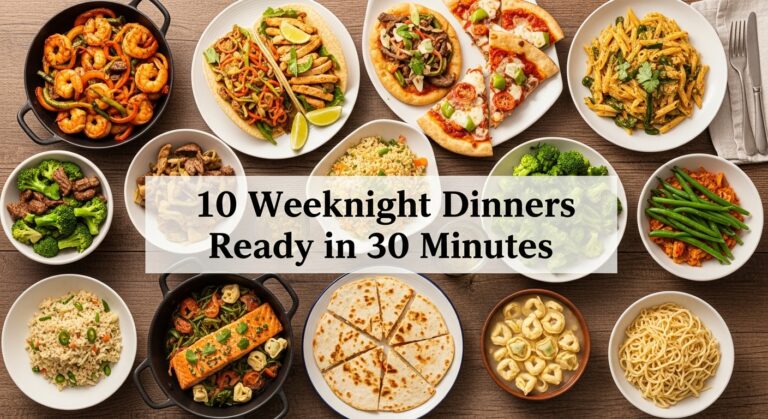
It’s 5:30, dinner isn’t started, and the same question comes up again: what can you make tonight without spending another hour in the kitchen? A five-day plan is easier to follow when the meals share groceries but don’t taste like the same dinner five times.
This 30-minute weeknight meal plan gives you Monday-through-Friday dinner ideas, a consolidated shopping list, and a way to use ingredients across the week. The meals are designed around quick-cooking or already-cooked ingredients. The clock includes basic prep, cooking, and serving—not an unmentioned hour of chopping. Times are planning targets, not tested guarantees; a crowded skillet, frozen protein, or extra batch may take longer.
What Should You Cook for Dinner Monday Through Friday?
Start with the week at a glance. These dinners use a skillet, pot, or air fryer rather than requiring a different appliance every night. The sample shopping quantities below are flexible starting points for four people, not a nutrition prescription or a formally tested five-recipe set.
| Night | Dinner | Approximate total time* | Make-it-work shortcut | Important condition |
|---|---|---|---|---|
| Monday | Chicken, broccoli, and quick rice | 25–30 minutes | Microwave-ready rice and cut-up chicken | Chicken must reach 165°F; extra batches add time |
| Tuesday | Chicken and bean quesadillas | 15–20 minutes | Use safely cooked chicken already in the fridge | Don’t put raw chicken in a quick quesadilla |
| Wednesday | Pesto pasta with white beans and spinach | 20–25 minutes | Canned beans and bagged spinach | Choose pasta that finishes within the time available |
| Thursday | Fully cooked sausage and peppers | 20–25 minutes | Slice the vegetables while the skillet heats | Raw sausage follows different cooking instructions |
| Friday | Vegetable and egg fried rice | 15–20 minutes | Shelf-stable ready-rice pouches and frozen vegetables | Use fresh ready-rice, not rice left in the fridge since Monday |
*The times assume ingredients are thawed or ready to use, sufficient pan space, and no unexpected extra batches. Follow package instructions and use a thermometer where appropriate.
Monday — Chicken, Broccoli, and Quick Rice
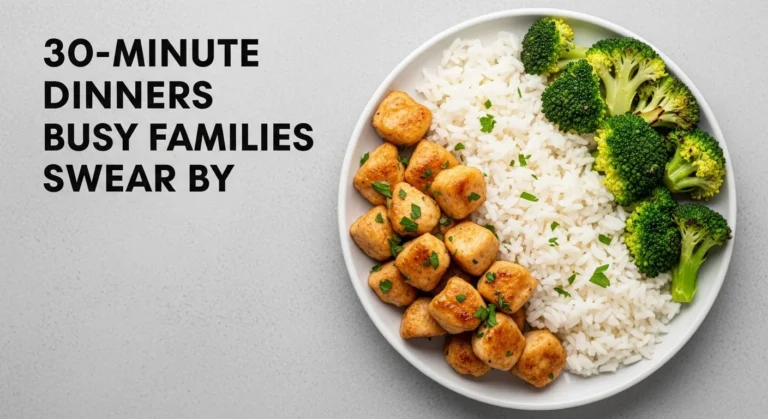
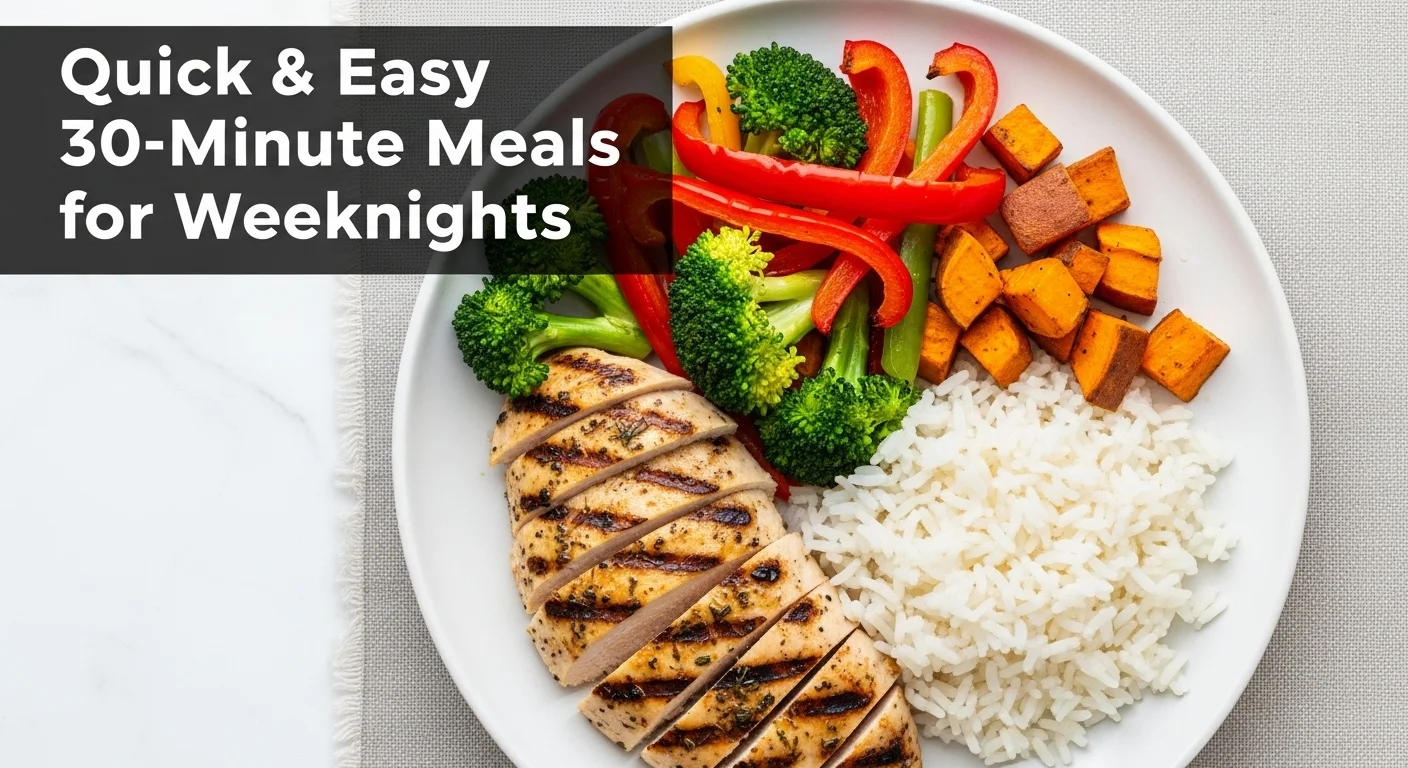
What to use: About 1½ pounds of boneless, skinless chicken breast for four, a 12–16-ounce bag of broccoli florets, ready-to-heat rice, cooking oil, and a seasoning blend you like.
Cut chicken into similar-size pieces and season it before the pan gets hot. Cook it in a lightly oiled large skillet, turning as necessary, until the thickest pieces reach 165°F. Microwave or steam broccoli while the chicken cooks, then prepare the rice according to the package. A squeeze of lemon or a little garlic butter changes the flavor without starting another sauce from scratch.
Where this plan can slip: A small skillet loaded with 1½ pounds of chicken may steam the pieces or require two batches. Split the batch and allow more time rather than crowding the pan. For a cut-specific method, see our air fryer chicken tenderloins guide.
For Tuesday: Quesadillas need already cooked chicken. If you’re not deliberately cooking additional chicken ahead of time, add a separate package of fully cooked chicken to your shopping list. Don’t count on making an oversized Monday chicken batch in the same 30-minute window.
Tuesday — Crispy Chicken Quesadillas Using Cooked Leftovers
What to use: Eight medium tortillas, around two cups of safely cooked shredded chicken, a can of drained black beans, shredded cheese, and salsa. You can use less chicken and more beans if that’s what you have.
Place a little chicken, beans, and cheese on one half of each tortilla; fold and heat in a skillet until the tortillas are crisp and the filling is thoroughly hot. Add salsa after cooking and serve with sliced peppers or a simple salad. If you prefer an air fryer, use our air fryer quesadilla method and account for however many batches your basket needs.
Where this plan can slip: This is a 15–20-minute dinner because the chicken is cooked. If your only chicken is raw or frozen, switch to bean-and-cheese quesadillas instead of rushing raw poultry inside a folded tortilla. Reheat any cooked chicken leftovers to 165°F.
Wednesday — Pesto Pasta With Beans and Spinach
What to use: About 12 ounces of quick-cooking dry pasta, one can of white beans, a bag of baby spinach, and roughly half to one small jar of pesto, adjusted to taste.
Start a pot of water immediately. While the pasta cooks, rinse the beans and set the spinach nearby. Save a little pasta water before draining. Stir the hot pasta with beans, spinach, pesto, and enough reserved water to loosen the sauce. Heat until the beans are hot and the spinach wilts. Add a salad or fruit if you want a side that takes no extra burner.
Where this plan can slip: Thick pasta shapes with long package cooking times can push the meal over half an hour. Choose a faster shape or use a ready-to-heat grain if you are starting late. Beans make the dinner more substantial without requiring another raw meat preparation.
Thursday — Fully Cooked Sausage and Peppers
What to use: A 14–16-ounce package of fully cooked sausage, two bell peppers, an onion, oil, and four rolls or another ready-to-serve side.
Slice the sausage, peppers, and onion. Cook the vegetables in a large skillet until as tender as you like, add the sausage, and heat through according to its package instructions. Serve in rolls, or with a simple side that doesn’t require a second long cooking session. Our air fryer kielbasa guide is another option when you prefer that cooking method.
Where this plan can slip: Check the label. Raw sausage isn’t the same as fully cooked sausage; it needs appropriate cooking time and a verified safe internal temperature. Don’t use a short reheating method for raw links.
Friday — Vegetable and Egg Fried Rice
What to use: Four to six eggs, roughly 12–16 ounces of frozen mixed vegetables, two ready-rice pouches for four people (adjust to appetite and package serving sizes), a little oil, and soy sauce or another favorite seasoning.
Cook the frozen vegetables in a wide skillet until hot. Move them aside, add beaten eggs, and cook until the eggs are fully set. Prepare the rice according to its package, add it to the skillet, and toss everything together until steaming hot. Taste before adding extra salt because some sauces are already salty.
Where this plan can slip: Using rice cooked on Monday and refrigerated until Friday is not the shortcut this plan assumes. Use a fresh shelf-stable ready-rice pouch on Friday, or rice you previously cooled promptly and froze in portions. This also means your Friday dinner doesn’t depend on leftovers surviving all week.
How Do You Shop Once for Five Quick Weeknight Dinners?
This is a sample list for four people. Check what you already have before buying everything. Package sizes and appetites vary, and leftovers depend on how much your household actually eats.
| Grocery group | Suggested starting amount for four | Used on |
|---|---|---|
| Boneless chicken breast | About 1½ lb | Monday |
| Already cooked chicken | About 2 cups, unless separately cooked ahead | Tuesday |
| Fully cooked sausage | 14–16 oz | Thursday |
| Eggs | 4–6 | Friday |
| Canned black beans | One 15-oz can | Tuesday |
| Canned white beans | One 15-oz can | Wednesday |
| Broccoli florets | 12–16 oz | Monday |
| Bell peppers and onion | 3 peppers and 1 onion | Tuesday (optional pepper), Thursday |
| Baby spinach | One 5-oz bag | Wednesday; any extra can go into Friday’s rice |
| Frozen mixed vegetables | One 12–16-oz bag | Friday |
| Ready-rice pouches | About 4 pouches total, depending on size | Monday and Friday, opened on each day |
| Medium tortillas | Around 8 | Tuesday |
| Dry pasta | About 12 oz | Wednesday |
| Bread rolls | 4, optional | Thursday |
| Cheese, pesto, salsa | Small packages/jars | Tuesday and Wednesday |
| Oil, garlic or seasoning, soy sauce | Check pantry first | Several nights |
If you’re cooking for two, start with roughly half these amounts and buy the smallest practical packages. For a larger family, increase portions, but check whether your skillet or air fryer can actually cook the extra protein without multiple rounds. A smaller amount cooked properly is better than promising a 30-minute meal with a pan that cannot hold it.
Which Ingredients Can You Reuse Without Making Every Dinner Taste the Same?
The trick is to reuse the shopping ingredients, not the same flavor profile. A pepper can go into a crisp quesadilla filling on Tuesday and a savory sausage skillet on Thursday. Beans can be a filling or a pasta add-in; you don’t need to season both dishes the same way.
| Shared item | First use | Later use | Keep the meals different |
|---|---|---|---|
| Bell peppers | Sliced alongside Tuesday’s quesadillas | Cooked with Thursday’s sausage | Fresh and crunchy Tuesday; soft and savory Thursday |
| Beans | Black beans in quesadillas | White beans in Wednesday’s pasta | Tex-Mex-style filling versus pesto and spinach |
| Spinach | Wilts into Wednesday’s pasta | Optional addition to Friday’s fried rice | Add leftover greens only if still fresh and properly refrigerated |
| Rice pouches | Open packets for Monday’s side | Open separate packets on Friday | Garlic- or lemon-seasoned Monday; soy-seasoned Friday |
| Cooked chicken | Prepared separately ahead or stored safely after a larger meal | Tuesday’s quesadilla filling | Change seasoning with salsa, beans, and cheese |
There’s no requirement to keep an opened ingredient until Friday. If produce starts to deteriorate, use it earlier, freeze it when suitable, or substitute a frozen option. Keep raw meat separate from ready-to-eat vegetables and cooked foods.
What Can You Prepare Ahead to Make Weeknight Cooking Easier?
You don’t have to cook five dinners on Sunday. A small amount of setup can remove the jobs that tend to slow down your first ten minutes of cooking.
- Check the protein: Is Monday’s chicken safely thawed? Will Tuesday’s cooked chicken be available, or should Tuesday be bean quesadillas?
- Check the vegetables: Put frozen broccoli and mixed vegetables on your list if fresh chopping is likely to be a struggle. Slice peppers nearer their planned use and refrigerate them properly.
- Check the starches: Set aside microwave rice for Monday and separate unopened pouches for Friday. Keep pasta and tortillas easy to find.
- Check your tools: Have a clean skillet, pot, spatula, and food thermometer ready. If you plan to use an air fryer, account for preheating when your appliance calls for it.
If you prep chicken ahead, refrigerate or freeze it safely; don’t leave it on the counter. Raw poultry generally needs to be cooked or frozen within one to two days of refrigeration. Use the package date and storage condition as additional checks.
How Do You Keep Each Dinner Within 30 Minutes?
Treat the clock as a whole-meal limit rather than a cooking-time label. A practical plan accounts for setup, the main heat step, the side, and serving.
| When you start | Do this | Why it matters |
|---|---|---|
| Minutes 0–5 | Take out ingredients, start the longest heat step, check your equipment | Avoids discovering halfway through that the rice or pasta isn’t ready |
| Minutes 5–12 | Cut or assemble the main ingredients while water heats or the first batch cooks | Keeps prep and cooking moving together |
| Minutes 12–23 | Cook the main dish, prepare a simple side, check doneness | Prevents a cooked main from waiting for a complicated side |
| Minutes 23–30 | Finish heating, taste, plate, and clean the most time-sensitive utensils | Makes the plan about dinner on the table, not only a timer ending |
This is an illustrative workflow, not a tested schedule for every meal. If a chicken batch hasn’t reached 165°F by minute 23, it needs more time. Use a salad or ready-to-eat side instead of speeding up cooking unsafely. For a more detailed cooking-order example, see our realistic 30-minute dinner workflow.
What Should You Cook When Your Weekly Dinner Plan Falls Apart?
A useful weekly plan still works when Tuesday’s cooked chicken gets used for lunch or you discover Thursday’s sausage is raw instead of fully cooked. Swap the role of the ingredient, rather than starting a completely unrelated dinner.
| Problem | Fastest reasonable adjustment | What not to do |
|---|---|---|
| No cooked chicken for Tuesday | Make bean-and-cheese quesadillas; add salsa and sliced vegetables | Use raw chicken inside a 6-minute quesadilla |
| No pasta or no time to boil water | Turn Wednesday’s beans, spinach, and pesto into a warm rice bowl using a fresh ready-rice pouch | Assume every pasta shape cooks in the same time |
| Sausage label says raw | Move sausage to a night with enough cooking time; use beans or a fully cooked option tonight | Treat raw sausage as a quick reheating ingredient |
| Only one small air fryer basket | Use a skillet for the main or choose an already-cooked filling | Pile multiple servings into an overcrowded basket |
| No usable vegetables left | Use a properly stored bag of frozen vegetables | Use produce that is spoiled or improperly stored |
| No reliable leftovers for Friday | Use sealed shelf-stable rice and frozen vegetables | Keep Monday rice in the fridge all week and assume it’s fine |
If most of the week’s groceries have been used, eggs, canned beans, tortillas, and frozen vegetables can still form a fast backup dinner. You can also use the air fryer dinner ideas under 30 minutes when you want a different main dish without rebuilding the whole shopping list.
How Do You Store and Reuse Ingredients Safely During the Week?
Cooking ahead saves time only when the food remains safe to eat. Use a food thermometer for raw poultry, keep raw meat separate from ready-to-eat ingredients, and label cooked leftovers with the day they were prepared.
Refrigerate perishable food and cooked leftovers within two hours of preparation (within one hour when temperatures exceed 90°F). Use shallow containers for prompt cooling and keep your refrigerator at 40°F or below. Most refrigerated cooked leftovers should be eaten within three to four days or frozen for longer storage. Reheat leftovers to 165°F. These are standard food-safety guidelines, not optional time-saving shortcuts; see the government safe-storage guidance and safe minimum cooking temperature chart.
For this menu, Tuesday’s properly chilled cooked chicken can be an appropriate next-day leftover. Friday’s rice should come from a separate shelf-stable pouch or a safely frozen portion, not from a pot left sitting for days. Frozen raw poultry should be thawed in the refrigerator or with another approved safe method—not on the countertop.
Bonus Value: The 10-Minute Weekly Dinner Setup Card
Here’s the part worth saving to your phone or putting on the fridge. Rather than prepping every meal, spend about ten active minutes making sure each night has a workable starting point. The goal is to prevent a missing ingredient from becoming a 7 p.m. dinner emergency.
| Check | Your answer for this week | If the answer is no |
|---|---|---|
| Monday: Is the chicken safely thawed and the rice ready to heat? | Yes / No | Switch to cooked chicken or bean bowls; don’t thaw on the counter |
| Tuesday: Is there cooked chicken available? | Yes / No | Make bean-and-cheese quesadillas |
| Wednesday: Do we have fast-cooking pasta, beans, and pesto? | Yes / No | Make a warm bean-and-spinach rice bowl |
| Thursday: Does the sausage label say fully cooked? | Yes / No | Use a cooked alternative or move the raw sausage to another day |
| Friday: Do we have unopened ready-rice, eggs, and frozen vegetables? | Yes / No | Make an egg-and-vegetable skillet with toast or tortillas |
Two-minute nightly rule: Before heating anything, confirm one ready protein, one ready carbohydrate, and one vegetable. If a key ingredient requires an unplanned thaw or long cooking session, use the matching fallback above. That’s how you protect the whole dinner schedule instead of trying to make an unrealistic recipe timer work.
This card is a planning tool, not a claim that every dinner has been kitchen-tested in exactly 30 minutes. Update the answers each week as household portions and available equipment change.
Frequently Asked Questions About Planning 30-Minute Weeknight Meals
Can you really cook five different dinners in 30 minutes each?
Often, yes, when the ingredients are ready and you’re not doing extra batches. This plan deliberately uses cooked chicken for Tuesday, fully cooked sausage for Thursday, and ready-rice for Monday and Friday. Actual cooking time varies with portion size and equipment.
Do you need to prepare everything on Sunday?
No. Checking your ingredients and making sure Tuesday’s chicken is cooked is more useful than cooking a whole week’s meals. Prep only what you can refrigerate or freeze safely.
How do you plan 30-minute meals for two people?
Start with roughly half the sample shopping amounts, then account for package sizes. A four-portion recipe may be worth making when you plan to refrigerate or freeze the extra servings safely.
What if your family doesn’t like one of the planned dinners?
Keep the meal’s structure and change the main ingredient. For example, Tuesday can be bean-and-cheese quesadillas, Wednesday can use different vegetables with pesto pasta, and Thursday can become a bean-and-pepper skillet instead of sausage.
Can you keep cooked chicken or rice in the refrigerator until Friday?
Don’t make Friday depend on Monday’s leftovers. Cooked leftovers are generally used within three to four days when refrigerated safely; freeze portions you intend to keep longer. This plan uses a new ready-rice packet on Friday.
A quick weeknight meal plan works best when it gives you choices, not another rule to follow. Keep the five dinners, shopping list, and 10-minute setup card together. Then change one ingredient at a time when the week doesn’t go exactly as planned.