30-Minute Dinners for Busy Families: Cook Once, Feed Everyone

When you have 30 minutes to make dinner for four or six people, the problem isn’t always finding a quick recipe. It’s making enough food in the time you have. A skillet dinner that works for two can turn into a 45-minute job when you need three batches, and a fast main dish isn’t much help if the side still needs another 20 minutes.
For 30-minute dinners for busy families, start with one main dish that fits your equipment, a side that needs little attention, and toppings people can choose for themselves. Below are five flexible meals, ways to scale them for different household sizes, and a Family Dinner Capacity & Task-Split Card to check your plan before you turn on the heat. The timing examples are planning estimates, not guaranteed or kitchen-tested results.
What Makes a Family Dinner Possible in 30 Minutes?
A meal can fit a 30-minute window when the ingredients are ready, the main food fits the pan or appliance, and the side finishes while you’re working on the main dish. Count the entire process—from taking food out of the refrigerator to putting plates on the table—not just the cook setting.
Use this sample time budget as a reality check:
| Stage | Planning allowance | What you need to do |
|---|---|---|
| Gather and prepare | 5–8 minutes | Wash produce, slice ready-to-cook ingredients, set out a clean board and seasonings |
| Cook the main | 12–16 minutes | Use a sufficiently large pan or a meal with already-cooked protein |
| Finish the side and toppings | Work alongside cooking | Warm tortillas, prepare ready-rice, dress a salad or set out toppings |
| Check and serve | 4–6 minutes | Check doneness, assemble plates and serve |
These jobs overlap, so don’t add every column as though it happens one after another. But if your chicken is frozen, the oven needs a long preheat, or your pan requires two rounds, change the menu rather than rushing the food.
Before choosing dinner, ask: Is my protein ready? Can I cook enough in one round? Does the side need a separate long step? If two answers are no, pick a meal built around fully cooked ingredients, beans, eggs or ready-to-use staples instead.
Which Dinner Methods Work Best for Feeding a Family Quickly?
Choose by usable cooking space, not the appliance name. A large skillet, oven sheet pan, pot and air fryer can all make weeknight dinners. What matters is how much food each can cook properly at once.
| Cooking method | Good family-size use | When it becomes slower | Easier adjustment |
|---|---|---|---|
| Wide skillet | Fajita filling, sausage and peppers, quick pasta sauce | Raw protein piles up and steams instead of browning | Use less protein per batch or start with fully cooked chicken |
| Sheet pan | Quesadillas, flatbread-style meals, thin vegetables | Folded tortillas or vegetables overlap | Use two pans with room between portions, or make a smaller menu |
| Large pot | Pasta with beans and vegetables | Water takes time to boil or a second pot is needed | Use a quick-cooking pasta and add vegetables toward the end |
| Assembly bowls | Ready-rice, warmed beans, cooked chicken, fresh toppings | Several raw components must be cooked first | Start with safely stored, ready-to-eat components |
| Air fryer | Small batches of chicken or vegetables | A family-sized portion needs repeated basket loads | Use it for one component and make the rest on the stove or counter |
An air fryer can still be helpful, but basket area matters. Our guide to air fryer dinners under 30 minutes explains how to decide what will fit together without crowding.
Five Practical 30-Minute Family Dinner Options
These are family-meal frameworks, not five independently tested recipe cards. The suggested quantities are starting points for roughly four portions; adjust them for appetites, age, available ingredients and sides. The time ranges assume a reasonable amount of ready-to-cook prep and a pan or pot that fits the meal. Always follow package directions and verify meat doneness rather than relying on the clock alone.
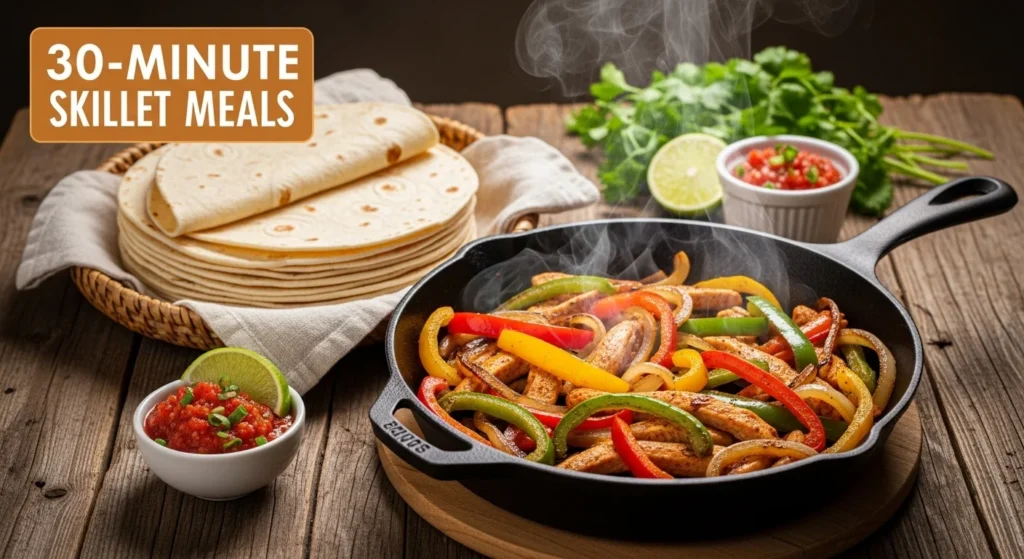
Chicken Fajita Wraps With Peppers
Best when: You have thawed, boneless chicken and a wide skillet, and everyone is happy building their own wrap.
For about four portions, start with 1½ lb of thawed boneless chicken, two bell peppers, an onion, fajita seasoning, and roughly eight small tortillas. Slice the chicken into even, bite-size strips. Slice the peppers and onion thinly so they soften without a long covered cook.
- Set out tortillas, salsa, lettuce or other ready-to-eat toppings before starting the main pan.
- Cook the chicken and vegetables in a lightly oiled wide skillet, stirring and turning so the chicken cooks evenly. If the pan is crowded, cook in separate rounds instead of piling everything together.
- Check the chicken in its thickest pieces with a thermometer: it must reach 165°F (74°C). Warm tortillas while the final ingredients finish, then let everyone fill their own wraps.
Time condition: Allow about 25–30 minutes if slicing is quick and the food fits your pan; an additional skillet batch may push the meal beyond 30 minutes. If you’re already running late, use safely handled, fully cooked rotisserie chicken and heat it thoroughly rather than starting raw chicken.
The existing air fryer chicken fajitas guide offers another method when you’re making a smaller quantity or have enough basket space.
Rotisserie Chicken and Bean Rice Bowls
Best when: You need a family dinner fast and can start with fully cooked chicken, canned beans and microwave-ready rice.
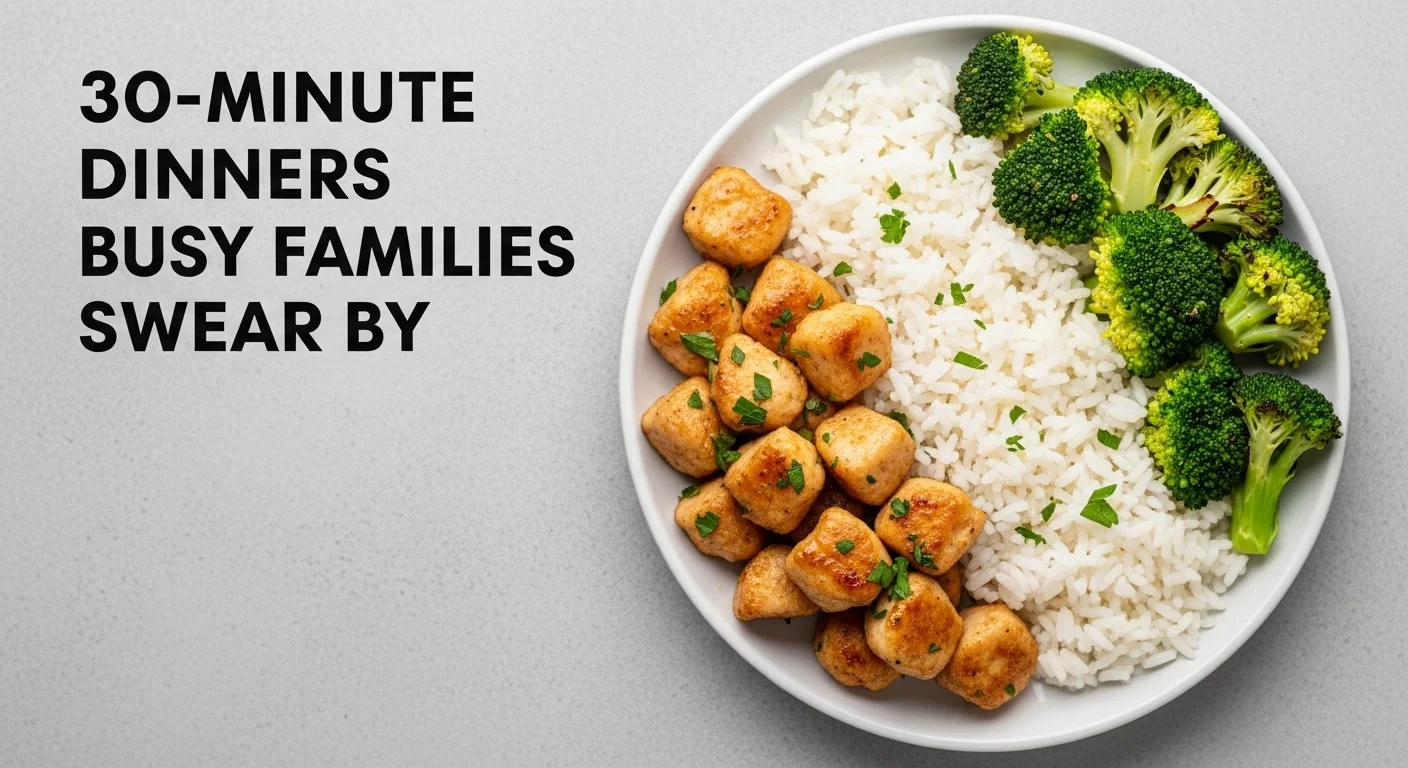
For about four servings, use a suitable amount of fully cooked rotisserie chicken, two 15-ounce cans of beans (drained), enough microwave-ready rice for four servings according to its package, and toppings such as shredded lettuce, salsa, tomatoes or shredded cheese. Keep crunchy and creamy toppings separate so each person can choose.
Warm the beans and rice according to their package instructions. If serving the cooked chicken hot as a leftover, reheat it to 165°F (74°C). Divide the base into bowls and let people add their preferred toppings. Using a microwave for rice while the stovetop warms the beans keeps the two jobs moving together.
Time condition: This can be a roughly 15–20-minute assembly dinner if the components are ready to use. It is not a 20-minute plan if you’re starting with raw chicken or uncooked dry rice.
Quick Pasta With Pesto, Beans, and Peas
Best when: You need a filling meat-free option that can feed several people from one pot.
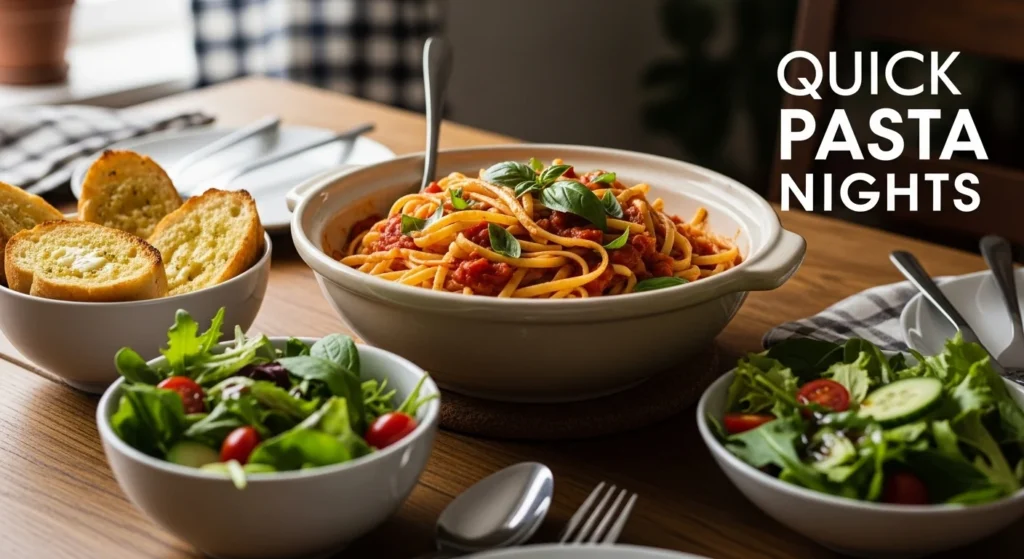
For four servings, start with about 12 ounces of quick-cooking pasta, one 15-ounce can of drained white beans, 1–2 cups frozen peas, and pesto to taste. Check the pesto label for allergens and dietary preferences; some varieties contain nuts or cheese.
Bring the pasta water to a boil and follow the pasta package timing. Add frozen peas toward the end so they heat through without needing a separate pot. Drain, reserving a little cooking water, then fold in the beans and pesto until everything is hot. Use reserved water to loosen the sauce rather than adding a second heavy sauce.
Time condition: Plan approximately 20–30 minutes depending on your stove, pasta shape and the time needed to boil water. If your pot is too small for six portions, use a larger pot or choose the rice bowls instead of forcing a huge pasta batch.
Fully Cooked Sausage and Peppers With Pita
Best when: You want a hot main dish but don’t want to manage raw chicken on a rushed evening.
For about four servings, use 12–16 ounces of clearly labeled fully cooked sausage, two bell peppers, an onion, and four to eight pita halves, depending on size and appetite. Slice the vegetables fairly thin, then cook them in a wide skillet until tender enough for your family. Add sliced sausage and heat it according to the package instructions. Serve in warmed pita with optional mustard, yogurt sauce or a side salad.
Time condition: A useful starting allowance is 20–25 minutes with ready-to-slice ingredients. A package labeled raw sausage requires a different cooking and doneness plan; don’t substitute it and keep the same schedule. If a large family portion crowds the skillet, warm the pita and use a simpler cold side instead of trying to cook more vegetables in the same pan.
For an alternative appliance method, our air fryer kielbasa guide explains how to handle a fully cooked sausage in a smaller basket.
Sheet-Pan Bean and Cheese Quesadillas
Best when: You want a vegetarian-friendly, hands-off main dish and have an oven and sheet pan available.
For roughly four servings, start with four large tortillas, one 15-ounce can of drained beans, about 1½ cups shredded cheese, and a small amount of finely chopped pepper or another ready-to-eat vegetable. Add optional cumin or salsa after baking. If your family needs more food, offer a simple salad, fruit or extra beans rather than stacking the quesadillas.
Set the oven to 400°F (204°C). Spread beans, cheese and finely chopped vegetables across half of each tortilla, fold closed and place on a lightly oiled sheet pan with space between them. Bake until the tortillas are golden and the cheese is melted, turning carefully if needed. Begin checking after about 8 minutes, but allow additional time depending on oven preheating, filling amount and the tortilla size.
Time condition: This is most realistic when the oven is ready quickly and all four folded tortillas fit in one layer. Six larger servings may need two pans or rounds, so count that before promising a half-hour dinner. A skillet version is often better for a small household; the air fryer quesadilla recipe is another option for smaller batches.
How Do You Adjust Dinner for Two, Four, or Six People?
Scale the food, then check the cooking surface. Doubling ingredients is easy on paper; doubling the number of chicken strips in one skillet usually isn’t. Portion needs also vary, so the chart is a starting shopping estimate for the fajita dinner rather than a nutritional rule.
| Household | Boneless chicken to start with | Bell peppers | Small tortillas | Likely equipment decision |
|---|---|---|---|---|
| 2 people | ¾ lb | 1 | About 4 | One moderate skillet may be enough |
| 4 people | 1½ lb | 2 | About 8 | Use a wide skillet and check for crowding |
| 6 people | 2¼ lb | 3 | About 12 | Expect a larger cooking surface or more than one batch |
You’ll also want onion, seasonings and your family’s usual toppings. These are illustrative raw chicken quantities, not tested exact yields, and tortillas per person depend on size and appetite.
For six people, a bean-and-rice bowl often scales more easily than six separate cooked quesadillas. For two, a smaller skillet can be enough. For four, check whether the main dish can be spread out rather than stacked. When it can’t, the honest answer may be 35–45 minutes or a different dinner.
How Can Everyone Eat From One Main Dish?
Keep one shared base and let people finish their own plate. That is usually easier than making one dinner for adults and a completely different dinner for children.
- For fajitas: Serve cooked chicken and peppers as the main filling. Offer tortillas, rice, lettuce and salsa separately. Someone who doesn’t want peppers can choose chicken with rice instead.
- For bowls: Put warm beans, rice and chicken on the table. Keep salsa, cheese and crunchy vegetables in small dishes so each person can customize without holding up the main food.
- For quesadillas: Keep one batch mildly seasoned; put stronger sauces or toppings on the side rather than changing every filling.
You don’t need to hide vegetables or pressure anyone to eat an unfamiliar food. Offer familiar components where possible, and plan serving sizes around the people at your table. If you need a broader range of ideas rather than one family-size workflow, the family dinner collection has more meal choices.
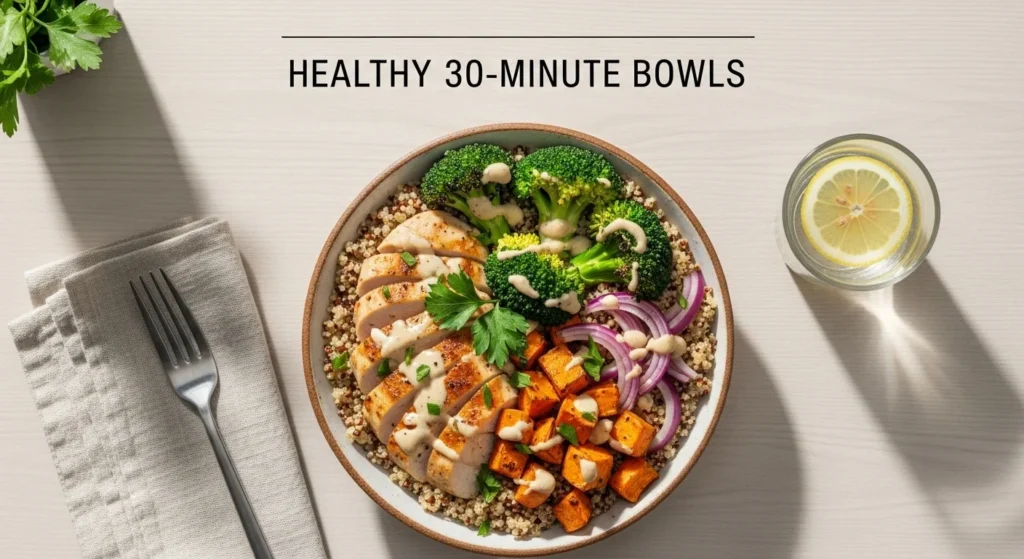
How Do You Make the Main Dish and Side Finish Together?
Give the longest job your attention first, then fit the side around it. Here’s a conditional example for chicken fajitas and a ready-to-eat side when two adults are available. It assumes thawed chicken, a large enough skillet and prewashed toppings.
| Approximate minute | Cook A: main dish | Cook B: side and serving |
|---|---|---|
| 0–5 | Slice chicken on a dedicated raw-meat board; season it | Wash and slice peppers on a separate clean board; set out plates |
| 5–10 | Begin cooking chicken in the wide skillet | Put tortillas, salsa and lettuce on the table |
| 10–20 | Continue cooking chicken and peppers; turn as needed | Warm tortillas; prepare ready-to-serve fruit or salad |
| 20–25 | Check thick chicken pieces for 165°F; continue cooking if needed | Set out toppings and empty plates |
| 25–30 | Move fully cooked filling to a clean serving dish | Help everyone assemble their wraps |
This is a planning example, not a verified 30-minute chicken cooking test. If the chicken isn’t at a safe temperature at minute 25, let it cook. If you’re cooking alone, choose a simpler side that can be plated while the skillet is going. Clean hands, utensils and surfaces after touching raw chicken; never put cooked food back on the raw-chicken plate.
For a detailed look at meal timing rather than family portions, see the step-by-step 30-minute dinner workflow.
What If Everyone Needs to Eat at Different Times?
Portion food safely rather than leaving the whole dinner on the counter. If one person eats at 6:00 and another gets home at 7:30, serve the first plate, then refrigerate the later portion promptly in a shallow container. Reheat leftovers to 165°F (74°C) before serving.
Perishable cooked foods should go into the refrigerator within 2 hours, or 1 hour when the air temperature is above 90°F (32°C). Use refrigerated leftovers within 3–4 days or freeze them for later. This applies to cooked rice as well as meats, vegetables and mixed dishes. The official safe-storage guidance explains these limits.
Keep cold toppings separate from hot fillings so they don’t become soggy. If someone arrives much later, reheat only their portion and add fresh lettuce, yogurt or salsa afterward.
Why Does Your 30-Minute Family Dinner Take Longer Than Expected?
The biggest delays usually come from a mismatch between your ingredients and your available cooking space. Use the problem you actually have to choose the fix.
| What went wrong | Why it adds time | What to do next time |
|---|---|---|
| Chicken was still frozen | Safe thawing or cooking from frozen changes the plan | Use canned beans or a safe fully cooked protein instead; don’t thaw meat on the counter |
| The skillet was crowded | Food cooks unevenly and browning slows | Use a larger skillet, make smaller batches, or choose a pot meal |
| The air fryer needed several loads | The basket couldn’t fit a family-sized portion | Use the air fryer for one side and cook the main in a larger pan |
| The side needed another pan | Prep and cleanup grew beyond the estimate | Choose salad, ready-rice, bread or fruit |
| The oven took longer to preheat | The menu counted baking but not startup time | Start preheating first or choose a stovetop meal |
| Everyone wanted different toppings | You made separate versions of the whole dish | Serve one base with a few optional add-ons |
Safe cooking beats a deadline. Use a thermometer for chicken and other raw meat; don’t judge doneness only by color. Refer to the official internal-temperature chart whenever you change a protein or cooking method.
Bonus Value — Family Dinner Capacity & Task-Split Card
Use this 60-second check before starting dinner. It works whether one adult is cooking or two people can share the work.
| Question | Choose your answer | What it means for tonight |
|---|---|---|
| How many people are eating? | 2 / 4 / 6+ | Estimate portions before you choose a cooking method |
| What is the main protein? | Raw and thawed / fully cooked / beans or eggs / still frozen | Raw ingredients need safe cooking time; frozen food may require a different menu |
| Can the main fit in one round? | Yes / No / Not sure | If no, count another batch or switch to a pot, skillet or assembly meal |
| What side is already easy? | Salad / ready-rice / bread / fruit / none | Choose the side that runs alongside the main dish |
| Who is doing the work? | One cook / two cooks | With one cook, pick fewer steps; with two, split raw prep and clean serving tasks safely |
| When will everyone eat? | Together / staggered | Keep later portions safely chilled and reheat them fully |
Fast decision rule: If you have more than one major delay—such as frozen chicken and a pan that needs two rounds—switch to warmed beans, a ready-cooked protein or a one-pot meal. Don’t try to make an impossible plan work by skipping safe cooking or storage steps.
For a family of six with only a small air fryer, for example, chicken fajita filling in one basket probably isn’t the efficient choice. A large pot of quick pasta with beans and peas, plus a simple salad, may fit your household better. That’s the useful result of this card: you choose the meal that matches the kitchen you actually have.
Frequently Asked Questions About 30-Minute Family Dinners
Can I make a 30-minute dinner for six people?
Yes, depending on the ingredients and cooking surface. One-pot pasta, large-skillet meals and assembly bowls can scale more easily than food that needs multiple air fryer batches. Check the cooking capacity first and treat the 30-minute estimate as conditional.
What if I only have one pan and no oven?
Try pesto pasta with beans and peas, fully cooked sausage and peppers, or a rice-bowl dinner assembled from ready-to-use ingredients. Choose one cooking method and a side that doesn’t require a second hot pan.
How much chicken should I buy for four people?
For the fajita-wrap example here, 1½ lb of raw boneless chicken is a reasonable shopping starting point for four, alongside peppers and tortillas. Your household may want more or less depending on appetites, ages and other side dishes. If your skillet can’t hold the amount without crowding, cook in batches or change the meal.
Do I have to cook separate food for picky eaters?
Not necessarily. Build tacos, rice bowls or quesadillas around one main base and serve toppings or sauce separately. That gives everyone choices without requiring a separate full dinner.
Can I leave dinner out for a family member who comes home later?
Don’t leave perishable cooked food sitting at room temperature for hours. Refrigerate it promptly in a shallow container and reheat leftovers to 165°F (74°C) when the person is ready to eat. Follow the two-hour refrigeration limit, reduced to one hour when temperatures exceed 90°F.
The Family-Dinner Rule That Saves the Most Time
The most useful 30-minute family dinner is the one you can cook in the available space, for the number of people eating, with the ingredients already on hand. Choose the main dish first, keep the side simple, and let toppings stay flexible. When the plan needs extra batches or unsafe shortcuts, switch meals instead of trying to beat the timer.