Air Fryer Size Guide: How to Choose 2QT, 4QT, 5QT or 6QT

Choosing an air fryer size is harder than looking at the number of people in your household. Two air fryers can both say 6QT on the box but give you very different amounts of useful space for fries, chicken, vegetables, or a full dinner.
A better way to choose is to look at what you cook, how much food needs to spread across the basket, how many batches you’re willing to make, and how much counter space you have.
This air fryer size guide will help you compare 2QT, 4QT, 5QT, and 6QT models without assuming that one capacity automatically fits a certain number of people.
What Air Fryer Size Do You Actually Need?
Start with a capacity range, then compare the exact basket dimensions before buying.
| How you expect to use it | Capacity range to compare | What matters most |
|---|---|---|
| Snacks, reheating, one small portion | 2–4QT | Compact footprint and enough basket floor for your usual food |
| Regular meals for one or two | 4–6QT | Usable cooking area and whether you’re comfortable making a second batch |
| Several portions at once | 5–6QT+ | Wide basket floor and fewer cooking rounds |
| Main and side at the same time | Larger single basket or dual-zone | Whether you need one large cooking area or two separate zones |
| Meal prep or larger batches | 6QT+ | Food fit, counter space, and batch tolerance |
These are starting ranges, not serving guarantees.
A tall 6QT basket may not give you more room for four flat chicken cutlets than a wider 5QT basket. Likewise, a dual-basket appliance may advertise a large total capacity while dividing that space between two smaller drawers.
Advertised Quarts vs Usable Cooking Space
Air fryer capacity is normally listed in quarts, but quarts describe volume. They do not tell you how much flat cooking surface you have.
That difference matters because many foods air fry best when they have room around them instead of being piled deeply in the basket.
Think about these two hypothetical baskets:
- one is narrow and deep
- one is wide and relatively shallow
They could have similar total volume while behaving very differently when you try to arrange chicken breasts, fish fillets, fries, vegetables, or pizza slices.
Quarts Measure Volume, Not the Shape of Your Meal
A capacity label helps you compare general appliance size, but it doesn’t tell you exactly what will fit.
Before ordering an air fryer, look for:
- basket or crisper-plate width
- basket depth
- usable interior height
- shape of the cooking area
- whether the stated capacity is one basket or divided between multiple zones
If a manufacturer gives only exterior dimensions, check the manual or product documentation for more detail.
Wide vs Deep Air Fryer Baskets
A wider basket is often more useful when you cook foods that need to lie relatively flat.
Think:
- chicken breasts
- cutlets
- fish fillets
- burgers
- vegetables
- fries
- wings
- reheated pizza
A deeper basket can be useful for taller foods, but additional height does not automatically give you more room to spread food across the bottom.
This is why moving from 5QT to 6QT does not always mean you’ll fit dramatically more food in one layer.
Square vs Round Air Fryer Baskets
Basket shape also affects how easily food fits.
A square or rectangular cooking area can make it easier to arrange longer or irregularly shaped pieces. A round basket can still work perfectly well, especially for smaller portions, but the curved edges may affect how certain foods fit.
Don’t choose solely by shape. Compare the actual cooking area of the models you’re considering.
Why Food Height Sometimes Matters More
Flat cooking area isn’t the only consideration.
If you want to cook a whole chicken or another taller item, interior height becomes important too. In that situation, a deeper basket may be more useful than a wider shallow design.
Match the basket to the food you actually plan to cook instead of looking for one basket shape that is supposedly best for everything.
Air Fryer Size Decision Table
Use this table to narrow your search before comparing individual models.
| Household and use | Typical food | Batch tolerance | Counter-space needs | Capacity range to compare | Basket-shape consideration |
|---|---|---|---|---|---|
| One person, mostly snacks or reheating | Leftovers, nuggets, fries, small sides | Fine with small portions | Very limited space | 2–4QT | Compact basket may matter more than maximum volume |
| One or two people cooking regular meals | Chicken pieces, vegetables, fries, reheated meals | A second round is sometimes acceptable | Moderate space | 4–6QT | Look for enough flat area for your common foods |
| Several portions at once | Protein, vegetables, wings, fries | Prefer fewer batches | More counter room available | 5–6QT+ | A wider cooking surface becomes increasingly useful |
| Main and side together | Protein plus vegetables or two foods with different timing | Want to avoid separate rounds | Larger footprint is acceptable | 6QT+, dual-zone, or flexible-zone | Decide whether you need one big zone or two separate ones |
| Frequent meal prep or larger batches | Multiple portions | Very low batch tolerance | Plenty of space | 6–8QT+ | Compare actual floor area rather than capacity alone |
| Taller food or whole poultry | Whole chicken and other bulky foods | Depends on the meal | Varies | Model-specific | Interior height and basket shape matter |
The household column helps you narrow your choices, but the other columns should make the final decision.
How 2QT, 4QT, 5QT and 6QT Air Fryers Differ
The biggest difference between capacities is not simply how many people they supposedly serve. It is how easily your normal foods fit and how often you’ll need another cooking round.
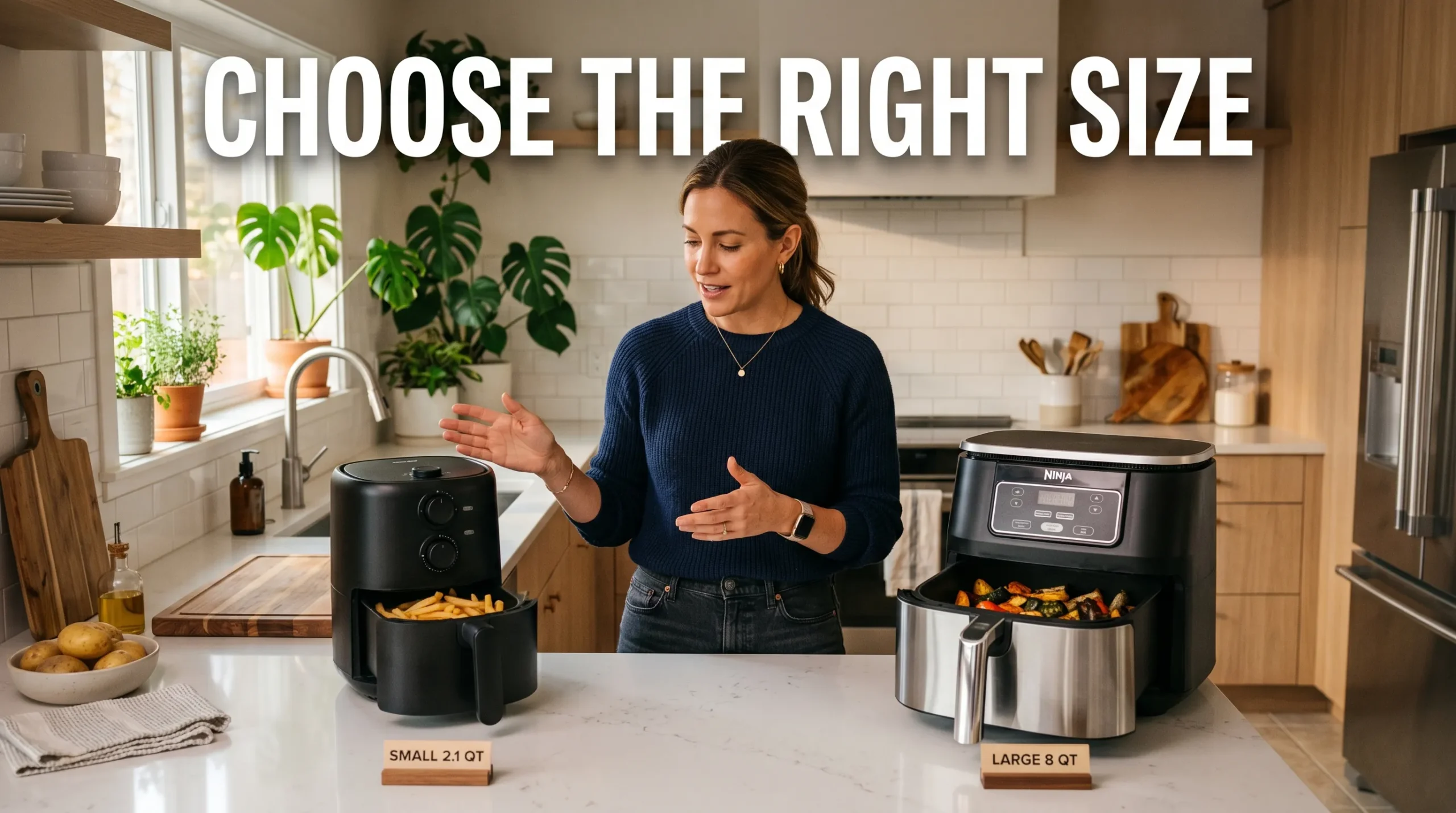
2QT — Best When Compact Size Matters Most
A 2QT air fryer makes the most sense when you value a small footprint and usually cook modest amounts.
It can be useful for:
- reheating leftovers
- a small portion of fries
- nuggets
- snacks
- small vegetable sides
Its biggest limitation is flexibility. Once you start cooking larger proteins, complete meals, or several portions, you may need multiple batches.
If you’re seriously considering this size, read the deeper guide on whether a 2QT air fryer is too small before deciding.
4QT — More Room Without a Large Appliance
A 4QT air fryer can provide a useful step up without taking the counter space of many larger appliances.
But don’t assume every 4QT model fits the same food.
One model may have a broad square basket while another uses more of its capacity vertically. That difference can determine whether two pieces of protein sit comfortably or overlap.
If 4QT is near the top of your shortlist, our guide to whether a 4-quart air fryer is big enough goes deeper into that specific decision.
5QT — A Useful Middle Ground
A 5QT model sits in an interesting middle range.
It can give you more flexibility than many compact models while avoiding the footprint of some larger machines. That makes it worth comparing when you regularly cook meals but don’t automatically want the biggest appliance available.
Again, the shape matters.
A well-designed 5QT basket with a useful flat surface could suit your cooking better than a taller appliance carrying a larger capacity number.
6QT — More Capacity, but Check Where the Extra Space Goes
A 6QT air fryer is worth comparing when you regularly cook several portions or want to reduce batch cooking.
Before paying for the larger capacity, find out what you’re actually gaining.
Ask:
- Is the basket wider?
- Is it deeper?
- Is most of the additional capacity vertical?
- Does it fit more of the foods you normally cook in one layer?
- How much larger is the appliance on the counter?
If you are specifically shopping for Ninja models in this general size range, the Ninja air fryer model comparison separates the different capacities and features instead of treating “Ninja 6QT” as one appliance.
Match the Basket to What You Actually Cook
One of the easiest ways to choose an air fryer is to stop thinking about quarts for a moment and think about dinner.
Write down the three foods you’ll cook most frequently.
Then ask how they need to sit in the basket.
Fries, Nuggets and Wings
These foods can tolerate some movement and tossing during cooking, but packing a large amount into a small basket can make browning and crisping more difficult.
If fries and wings are regular meals rather than occasional snacks, usable basket area deserves more attention.
For texture problems, these tips for getting crispy air fryer results explain why spacing and cooking technique matter.
Chicken Breasts, Cutlets and Fish
Flat pieces make basket width especially important.
A deep basket isn’t much help if the bottom only holds one large chicken breast comfortably and you need to cook several.
Look at the basket dimensions rather than relying on generic “serves four” language.
Vegetables
Vegetables are another case where surface area can be useful.
If you routinely roast enough vegetables to accompany several portions of protein, ask whether your planned basket lets you cook the amount you want without turning one dinner into several separate rounds.
Whole Chicken and Taller Foods
Here, vertical space becomes more important.
Don’t assume that every 5QT or 6QT model fits the same whole chicken. Check the documentation for the exact model and keep required clearance around the food in mind.
Leftovers and Pizza
Reheating is less about total capacity and more about shape.
If pizza slices, sandwiches, or flat leftovers are common, a broad cooking surface may be more valuable than a tall basket with a larger volume number.
Protein Plus a Side
This is where workflow matters.
A large single basket may allow compatible foods to cook together, while a dual-zone appliance can keep foods separate when they need different temperatures or times.
That decision can matter more than moving from one quart number to another.
A Simple Food-Fit Check Before You Buy
Before ordering an air fryer:
- Choose the largest food you cook regularly.
- Find the usable basket or crisper-plate dimensions for the model you’re considering.
- Think about whether that food needs to lie flat or can be tossed during cooking.
- Decide how much you normally cook at once.
- Ask whether you’d be happy running a second batch.
- Repeat the check for your next two most common foods.
This simple process gives you a better idea of practical capacity than a household-size label alone.
Single Basket vs Dual Basket vs Oven Style
Capacity numbers become even harder to compare when you switch air fryer formats.
| Format | What the capacity represents | Useful when | Main limitation to check |
|---|---|---|---|
| Single basket | One cooking chamber | You mostly cook one food or compatible foods together | Whether the basket floor is large enough |
| Dual basket | Combined capacity across two zones on many models | You want separate foods, times, or temperatures | Each individual drawer may be much smaller than the advertised total |
| Oven style | Larger chamber with racks or trays | You value tray space or multiple levels | Larger footprint and differences in airflow between rack positions |
A 10QT dual-basket appliance, for example, does not necessarily give you one continuous 10QT cooking area. Its capacity may be divided into two smaller cooking zones.
That can be excellent when you want chicken in one side and vegetables in the other. It is less helpful if your problem is fitting one large item.
For a deeper format comparison, see basket vs oven-style air fryers.
When Should You Go Bigger Than 6QT?
An 8QT or larger air fryer can make sense, but bigger should solve a specific problem.
Consider comparing larger models if:
- you strongly dislike cooking in batches
- you regularly prepare several portions at once
- you meal-prep multiple servings
- you frequently cook for guests
- your usual foods need more flat cooking surface
- you want independent cooking zones
- the larger appliance fits comfortably in your kitchen
Do not assume that moving from 6QT to 8QT automatically gives you 33% more useful cooking surface. The extra volume could come from greater basket height, a different shape, or a second cooking drawer.
That is why 8QT belongs in a size discussion, but it shouldn’t automatically be the recommendation for every larger household.
Measure Your Counter Before You Buy
A larger air fryer only saves time if it is convenient enough to use.
Before ordering, measure the area where the appliance will actually sit.
Check:
- overall width
- overall depth
- height beneath cabinets
- room needed to pull the basket fully forward
- room needed to open an oven-style door
- ventilation or clearance requirements in the exact model manual
- cabinet or shelf space if you plan to store it
- whether removable parts will fit comfortably in your sink or dishwasher
Pay special attention to working depth.
An appliance may fit on the countertop while closed but become awkward when you need to pull a large drawer toward you.
Also avoid using a universal clearance number. Follow the instructions for the exact appliance you buy.
A 5-Minute Air Fryer Size Checklist
If you’re still deciding between two sizes, use this order:
- List your three most common foods. Start with what you actually expect to cook.
- Decide how many portions you normally make. Use this as context, not as the only sizing rule.
- Decide how you feel about batches. A second cooking round may be fine for occasional use but frustrating at dinner every night.
- Compare usable basket dimensions. Look beyond the quart number.
- Choose one large zone or multiple zones. This separates single-basket from dual-basket needs.
- Measure the kitchen space. Include drawer opening and required clearances.
- Compare exact models. Only after the size and format fit should presets, extra functions, price, and styling make the final decision.
If two models seem equally suitable, the better choice is the one whose usable cooking area and workflow match your normal meals.
Frequently Asked Questions
Is a 4-quart air fryer big enough?
It can be, especially for smaller portions, but the answer depends on the exact basket dimensions and the foods you cook. Check how much can fit across the basket floor rather than relying only on the 4QT label.
What size air fryer should a family of four compare?
A family of four can reasonably compare several medium-to-large models rather than assuming one quart number automatically works. Basket area, meal type, and willingness to cook in batches should determine the final choice. For more detail, see our guide to choosing an air fryer size for a family of four.
Is a 2QT air fryer enough for one person?
A 2QT model can work well for one person who mainly cooks small portions, snacks, sides, or reheated food. It may still feel restrictive if you regularly cook complete meals or large pieces of food.
Should I choose a 5QT or 6QT air fryer?
Compare the exact basket dimensions first. A 6QT model is more useful when its extra capacity gives you space you can actually use for your normal food, rather than simply adding more height.
Is an 8QT dual-basket air fryer one large 8QT basket?
Not necessarily. Many dual-zone models divide their total advertised capacity between separate cooking drawers, so always check the capacity and dimensions of each individual zone.
Is 4L the same as 4QT?
No. Four liters is about 4.2 U.S. liquid quarts. Even when two capacity labels are close, the appliances can have different basket shapes and usable cooking areas.
Is a bigger air fryer always better?
No. Extra capacity can reduce batch cooking, but it also usually means more counter or storage space. The best size is the smallest model that comfortably handles the foods and quantities you normally cook without creating a workflow you dislike.
Final Takeaway
The best air fryer size isn’t determined by household size alone.
Start with the foods you cook, check how much basket floor they need, decide how much batch cooking you’re willing to do, and then make sure the appliance fits your kitchen. Use the quart number to narrow your search—not to make the final decision.
A well-shaped 5QT model can sometimes suit your meals better than a poorly matched 6QT model, while a larger or dual-zone appliance can be worth the space if it solves a real batch-cooking problem.
Choose the cooking space you’ll actually use.