Air Fryer Dessert Calorie Calculator + 15 Portion Ideas

Wondering how many calories are in your homemade air fryer dessert? Use the calculator below to estimate the calories in a complete batch and in the portion you serve, based on your actual ingredients and toppings. An air fryer does not remove calories from ingredients or guarantee weight loss; accurate portion estimates begin with the quantities you use.
Enter ingredient calories and the number of equal portions in the air fryer dessert calorie calculator. The printable-style worksheet and 15 portion examples help you organize ingredient-label values and count toppings. For actual cooking instructions and temperatures, see our healthy air fryer dessert methods. These are estimates for your own recipes, not 15 newly tested formulas, verified nutrition labels, or a personalized weight-loss plan.
Can Air Fryer Desserts Fit a Weight-Management Eating Pattern?
Yes, a dessert can be part of a broader eating plan. What matters for weight management is the overall pattern of food and drink, including the energy in what you consume, along with your individual needs. Air frying can make a small batch convenient, but the appliance does not change the calories in chocolate, butter, nuts, or sweetener that you add. The NIDDK weight-management guidance explains the importance of a sustainable eating plan rather than relying on one food or cooking technique.
You do not have to turn dessert into a contest to find the smallest number. A useful first step is to decide what sounds satisfying, serve the amount you intended, and check the ingredients that make the biggest difference to the recipe total. If you follow a medically prescribed eating plan or have special dietary needs, use guidance tailored to you.
How Can You Choose a Realistic Dessert Portion?
A portion is the amount you choose to eat. A serving size on a packaged food label describes a standardized amount that people typically consume; it is not automatically the amount you should eat. This distinction matters when your dessert contains several packaged ingredients. The NIDDK guide to food portions explains the difference.
- Decide the amount before cooking. Choose one ramekin, one fruit half, two filled dates, or a set number of same-size cookies depending on the recipe. These are examples of portion boundaries, not universal recommended serving sizes.
- Write down the complete batch. Note each ingredient’s quantity, including oil, butter, peanut butter, chocolate, honey, and toppings. If you change the recipe, update the calculation.
- Divide the batch intentionally. With a uniform mixture, make equal-size pieces or weigh the finished servings for a closer comparison. A small baking dish is only a container, not a nutrition measurement.
- Serve toppings separately when practical. It is easier to account for one measured spoonful of nut butter or chocolate than an unmeasured drizzle.
For example, dividing batter evenly between two identical oven-safe ramekins gives you two planned portions. If you add yogurt or chocolate to only one after cooking, include that extra ingredient in the portion you actually serve. The same approach works for muffins and brownies.
Calculate Calories Per Serving
Calorie Calculator for Your Dessert Batch
Enter calories for the actual quantity used, not grams or calories per 100 g. Use your ingredient labels or USDA food data. Leave any ingredient you did not use blank. All figures are estimates.
Enter ingredient calorie values to see your results.
Formula: (all batch-ingredient calories ÷ equal portions) + topping calories for one serving. Empty ingredient fields are excluded. This is a planning tool, not a nutrition-label analysis or weight-loss guarantee. Nothing is uploaded or saved.
Use the exact ingredients and amounts that you actually use. For packaged ingredients, check the nutrition label's serving size and calories. For unpackaged foods such as fruit, use a reputable food composition source, such as USDA FoodData Central, with the weight or edible portion that matches your recipe. If your measurement is in teaspoons but the label uses tablespoons or grams, convert the units before calculating.
- Record ingredient amount. Write down the weight, tablespoon measurement, or number of items used in the full batch.
- Find energy for that amount. Use the specific package label where available, or an appropriate USDA entry for unpackaged foods.
- Multiply for the actual amount used. If a label lists calories for a serving containing two tablespoons and you use one tablespoon, you are using half of that labeled serving.
- Add every ingredient's contribution. Include cooking oil, sweetener, chocolate, nut butter, toppings, and anything added after cooking.
- Divide by the number of equal portions. This gives an estimate for one portion only when the batch is divided reasonably evenly. If you eat two portions, account for two.
Simple formula: estimated calories per portion = (sum of calories from every ingredient in the batch) ÷ (number of reasonably equal portions). The value is an estimate because package labeling, food composition and portion sizes vary. If pieces are uneven, weigh the portions or calculate the ingredients of each piece instead of assuming they are equal.
Use this reusable worksheet for an apple crumble, then adapt it to a cookie, muffin, or brownie. Record your own amounts and calorie data: apple size, oat brand, butter quantity, and toppings can all change the estimate. No unverified calorie numbers are supplied.
| Ingredient / step | Amount or yield to record | Calorie reference | Calories for amount used |
|---|---|---|---|
| Apple | Edible prepared weight | USDA food entry | _____ |
| Rolled oats | Measured amount or weight | Your product label | _____ |
| Butter or oil | Amount added to recipe | Your product label | _____ |
| Sugar or syrup | Amount you actually add | Your product label | _____ |
| Nuts, chocolate or other extras | Measured weight or amount | Relevant product label | _____ |
| Total batch | Sum every ingredient above | Add the calorie entries | _____ |
| Number of portions | Count equal pieces or ramekins | Your finished batch | _____ |
| Estimated calories per portion | Batch total ÷ portion count | Calculated, not a nutrition claim | _____ |
| Toppings added to one portion | Measure after cooking | Product label or USDA entry | _____ |
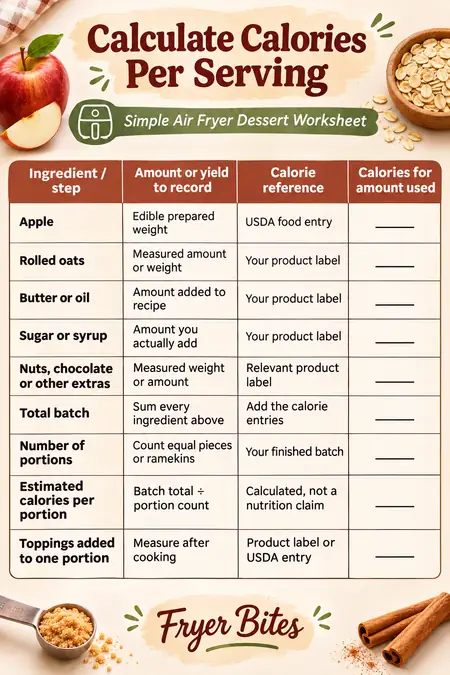
Visual worksheet: use the ingredient and portion fields above to record your label values. You can open the image for a closer view, or use the accessible text table above it.
Worked portion example (no guessed calorie values): Suppose one batch produces four evenly sized banana-oat cookies. If you eat two cookies, that is half of the batch's ingredient total. First calculate calories for the complete batch using your actual labels or USDA entries; then divide the batch total by four for one equal cookie, or by two for two. Add any toppings you put on your own serving. If cookies are not equal in size, measure their finished weights rather than assuming they each contain exactly one-quarter of the batch.
How Can You Portion These 15 Air Fryer Dessert Options?
The examples below focus only on how to count or measure a portion, not how to cook each recipe. They are neither tested calorie values nor prescribed serving sizes. For cooking methods, follow an individual recipe link where available or the dessert collection linked above; a variation mentioned here may require its own method.
| Dessert option | How to define your portion | What to measure or include |
|---|---|---|
| 1. Cinnamon apple chips | Keep track of the slices from one prepared apple; divide if sharing | Apple's edible weight, any added oil or sweetener |
| 2. Air fryer baked apple halves | Decide on one prepared half or both halves before serving | Apple, walnuts, butter, syrup or other filling |
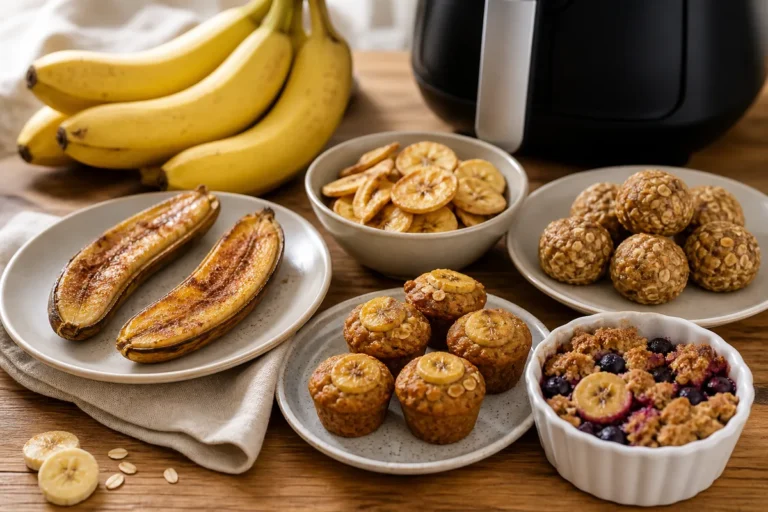
| 3. Banana oat cookies | Make similarly sized cookies and count those you serve | Whole banana, oats, any chocolate chips or nut butter |
| 4. Greek yogurt cheesecake cup | Count the whole ramekin if the complete mixture went into one dish | Yogurt, egg, honey or sugar, added toppings |
| 5. Peanut butter-stuffed dates | Count the prepared dates rather than estimating 'a handful' | Nut butter used per date, chocolate, date size |
| 6. Blueberry oat muffin | Portion the finished batter into evenly filled baking cups | Oats or flour, yogurt, egg, blueberries, sweetener |
| 7. Cinnamon banana halves | Choose one banana half or a pair of prepared halves | Banana amount, yogurt, honey or nut butter topping |
| 8. Pumpkin mug cake | Treat the whole ramekin as the batch unless you divide it | Flour, pumpkin, sugar, oil or other mix-ins |
| 9. Pear oat crisp | Use one small ramekin or divide a larger dish deliberately | Oats, pear, butter, honey or syrup |
| 10. Coconut macaroons | Form similarly sized mounds and count the ones served | Coconut, egg white, honey or other sweetener |
| 11. Chocolate brownie bite | Cut a fully cooked brownie into equal pieces before serving | Chocolate, cocoa, butter or oil, sugar and optional chips |
| 12. Warm strawberries with plain Greek yogurt | Measure the fruit and yogurt in the serving bowl | Yogurt type, fruit amount, granola or honey topping |
| 13. Sweet potato brownie bite | Portion the baked mixture after cooling so it holds together | Cooked sweet potato, nut butter, syrup, chocolate |
| 14. Apple oat crumble cup | Serve from a single ramekin or divide a larger prepared dish | Apple, oats, butter, sugar and extra toppings |
| 15. Mini chocolate cake | Decide whether the whole mini cake is one serving or multiple pieces | Cake mixture, frosting, chocolate and any sauce |
Two items with the same name can have very different ingredient totals. A brownie made with protein powder is not interchangeable with one made from a sweetened mix, and a fruit crisp can contain as much or as little topping as you prepare. Measure the version in front of you.
If you are choosing by ingredients rather than portions, use the cooking-method guide linked in the introduction. If banana ripeness affects your choice, the banana dessert guide explains the different textures.
Which Ingredients Change a Dessert's Calorie Total Most?
The ingredients worth measuring are usually the ones you add in relatively small but variable amounts. A tablespoon of nut butter, a generous handful of chocolate chips, and an unmeasured drizzle of syrup can change the calculation. That does not mean you have to avoid them; it means you should include them in the portion you planned.
| Ingredient or addition | What changes between servings | Practical check |
|---|---|---|
| Nut or seed butter | A thin layer and a heaped spoonful are not the same quantity | Measure before stuffing dates or adding a swirl |
| Chocolate, chips or frosting | Coating thickness and extra toppings vary | Use the amount listed on your chocolate package |
| Oats or flour | Recipes use different dry quantities and serving yields | Weigh or measure before mixing |
| Honey, maple syrup or sugar | A recipe with sweetener added after cooking includes that addition | Record the exact amount used |
| Plain vs sweetened yogurt | Nutrition differs by brand and type | Read serving size, calories and added sugars on the container |
| Butter or oil | Brushing a pan and stirring fat into a topping are different uses | Count the quantity that enters the recipe or finished food |
Honey and maple syrup count as added sugars for U.S. labeling purposes. A package marked no added sugar is not necessarily calorie-free. The FDA Nutrition Facts label guide can help you compare the ingredients you buy.
How Do You Choose Between Fruit, Oat, Yogurt, and Chocolate Desserts?
Choose based on the serving you want, then check the actual ingredients. You can enjoy any of these styles, but they are different to portion.
- If you want a clear fruit portion: A baked apple half or cinnamon banana half is easy to identify. Additions such as nuts, yogurt and syrup still need to be counted.
- If you want several small pieces: Oat cookies or coconut macaroons allow you to count pieces. Make them similar in size to improve the comparison.
- If you want something creamy: A yogurt cheesecake cup provides a defined container; check whether the whole mixture is intended as one portion and account for egg, sweetener and toppings.
- If you want chocolate: A brownie piece or mini cake may fit your plan, but you should check the batter and the size of the finished piece rather than assuming the air-fried version is lower in calories.
For ideas presented as under 200 calories, see our separate low-calorie air fryer dessert guide. Its estimates still need to match the ingredients and portions you actually prepare. This page intentionally does not repeat those calorie claims.
Why Doesn't a Small-Batch Dessert Always Mean Fewer Calories?
Small-batch describes the amount of food made, not the energy in the food. For serving-size and baking-dish choices when cooking for one or two, see our small-batch air fryer dessert guide. If you put all the batter into one small baking dish and eat the whole dish, you consumed the ingredients in the entire batch. Splitting the same batter into two equal servings changes the amount in each serving, not the amount contained in the full recipe.
A useful example is a ramekin brownie. One ramekin can hold a full mixture of flour, nut butter, chocolate and sugar. Calling it 'single serve' does not tell you its calories. Write down the whole ingredient list, calculate the batch total, and decide if you want all of it or part of it. The same check applies to cheesecake cups, mug cakes and crisps.
You also cannot remove calories simply by switching the cooking appliance. If two recipes use the same ingredient amounts and you eat the same portion, the air fryer is not a weight-loss shortcut.
What If You Need No Added Sugar or More Protein Instead?
These are different needs from portion planning. If you want to avoid sweeteners added to a recipe, follow our air fryer desserts without added sugar. It explains how to read labels and use naturally sweet ingredients. 'No added sugar' still does not mean zero calories or zero naturally occurring sugar.
If your priority is baking with protein powder, our protein air fryer desserts guide focuses on how protein ingredients change batter texture and doneness. Do not assume that a dessert is high in protein without calculating the nutrients for the actual brand and serving.
Frequently Asked Questions About Dessert Portions and Air Fryers
Can I eat an air fryer dessert while trying to lose weight?
Dessert can fit into an overall eating plan, but no individual recipe guarantees weight loss. Define a portion, consider the total ingredients and choose an approach that fits your needs.
How do I know whether a mini dessert is one or two servings?
Count the ingredients in the complete mixture and decide how many reasonably equal portions you make. A mini pan or mug does not set the nutrition serving for you.
Can I calculate calories without a kitchen scale?
You can estimate using labeled tablespoons, cups and pieces when those units match the food data. Weighing variable foods such as fruit, nut butter or uneven brownie pieces can improve accuracy.
Does swapping honey for sugar reduce calories?
Not automatically. The amount and type of sweetener matter, and both honey and syrup are added sugars. Compare the actual quantities instead of relying on a health label.
Are fruit desserts always lower in calories than brownies?
Not always. Compare the full recipe and the amount served. Fruit combined with large amounts of butter, sugar, nuts or toppings may differ considerably from plain cooked fruit.
Should I rely on a recipe's estimated calories?
Treat a recipe estimate as a starting point and check the actual ingredients, brand labels and serving yield. An unverified estimate should not be presented as a guaranteed number.
Do I need to skip desserts entirely for weight management?
You do not need to make that assumption. Focus on a sustainable overall eating pattern and portions you can understand; seek individualized guidance when medical or dietary circumstances require it.
Make Your Next Dessert Portion Easy to Understand
Choose one dessert you would genuinely enjoy. Before you cook, write down its complete batch ingredients, decide how many portions it will make, and measure toppings instead of adding them by guesswork. This gives you a clearer picture of your actual serving without promising that one dessert produces weight loss.
When you need the exact cooking method, return to our healthy air fryer dessert collection. It covers preparation, temperature starting points, ingredient variations and doneness checks; this page is for portion decisions.